Tuesday, November 24, 2020

An error in design

This time I thought that it would be nice to show you an amusing stamp design error that fits nicely in my collection.

Who doesn't love watching basketball? Well I will not lie to you, I don't, I find it to watch sports on TV, unless it is Rugby, but that's just me. But, and there is a but, to this day I remember Israel's win in 1977, in the Final Four.


The European League ("EuroLeague") in basketball (or formerly known as the "European Champions Cup") is an annual basketball competition between the best teams in Europe. The eternal Israeli champion, Maccabi Tel Aviv, participated in the EuroLeague regularly and even won the European Championship five times, for the first time in 1977. I remember when we won, people rushed into the streets, cars were hooting, noise everywhere and way past my bedtime.

Zaire issued a stamp dedicated to the 1984 Los Angeles Olympics shows and either accidentally or not, or probably just looking for a nice basketball image, used the image of one of Maccabi Tel Aviv's games in the EuroLeague. Sports fans among you will probably recognize Mickey Berkowitz, the greatest Israeli basketball player of all time.

Remember that in 1984, Google was just a big number (1 plus 100 zeros) and so it was not easy for them to do proper research.

As you probably know, the reason Israel, a Middle Eastern country, plays in the EuroLeague, is because of the cultural boycott of Arab countries over Israel.

Print Friendly and PDF

Tuesday, November 10, 2020

Spying on us

Here is a nice story for the day.

As we all know 15th May 1948, neighboring Arab countries invaded Israel from all sides, in what became known as the War of Independence. The day before, Israel declared independence from Britain as the Mandate ended. Knowing that there was going to be a war, many airlines stopped flights to Israel. TWA stopped flights as of 19th March 1948. TWA renewed flights to Israel, after the war, on the 5th July 1949.

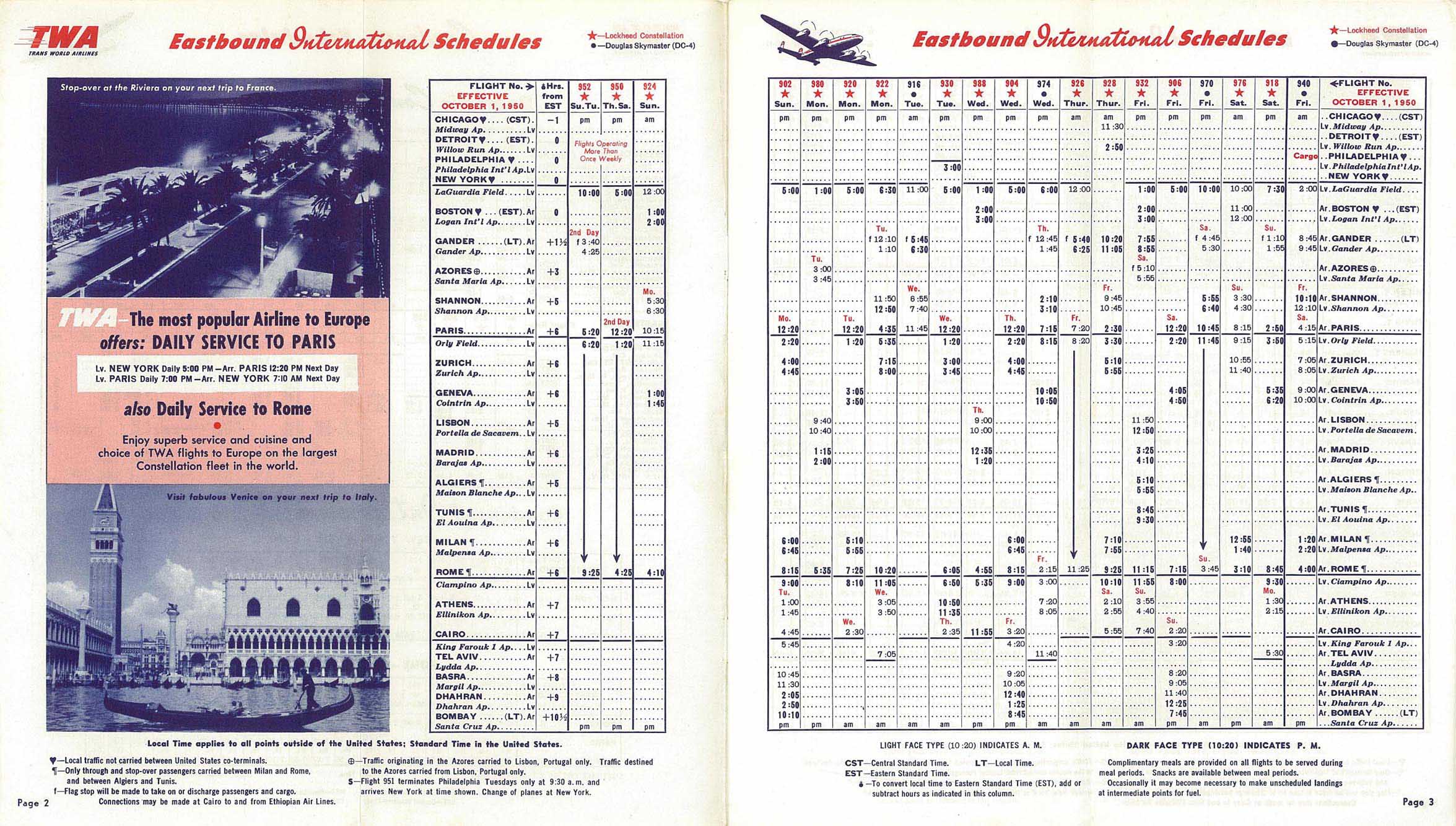
So a year later, a TWA flight left America for Israel in September 1950. In October 1950, and probably before that, the route was Rome - Athens - Tel Aviv, as can be seen from the image below.

The flight arrived in Rome, Italy and then departed on 18th September with 14 passengers and was scheduled to arrive at LYDDA airport, near Tel Aviv, that same day. Unfortunately due to engine trouble, the plane was forced to land in CAIRO.

Remember that September 1950 was barely a year and half after the ceasefire of the War of Independence and Israel and Egypt were not exactly on speaking terms. Egypt could not really come to terms with the fact that they were unable to wipe the Jewish state off the map. If they had, I wouldn't be writing this blog.

One could ask why would the flight land in Cairo, that seems very off route, if there was an Athens leg. One source said that the flight was forced to land in Egyptian occupied Gaza, which is highly unlikely as in 1950, as today, there is no landing strip there.

In Cairo, the mail bags were taken off the plane by the Egyptian Military. On board was mail originating from New York, Boston, Buenos Aires, Rio de Janeiro, Madrid and Rome. The Egyptian authorities refused to release the mail. Actually as of the 20th they hadn't even released the plane itself. Israeli authorities approached the International Postal Union and protested at the confiscation of Israel-bound mail.

There were about 19 mail bags on this flight. One source said that the mail was only released as a result of American threats. Mail was only returned to the sender after being heavily censored trying to get information. Mail began to arrive in Israel in February 1951, some six months later.

What is also puzzling here is that there were 14 passengers aboard, what happened to them while in Cairo? A question that I don't have an answer for. Anyone?


Print Friendly and PDF

Tuesday, October 20, 2020

Postkrieg or Postal War

In his book "On War", Carl von Clausewitz stated that "War is a continuation of politics by other means". Many of us have not heard the term Postkrieg or postal war. It is defined as a Postal War. Postal War is defined as measures taken, obviously for political reasons, by one country against another. It attacks postage stamps issued by a postal authority, postmarks, slogans or any postal material. 

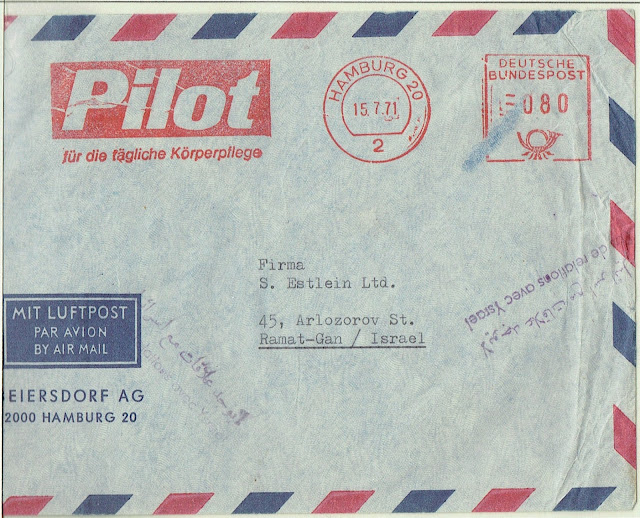
When dealing with our area, the Arab countries had no postal relations with us and letters sent to Israel, but landing up in Arab countries, were returned to sender after application of a cachet. But that is a simple case of a boycott against us or a lack of postal relations. However this is a continuation of the war and fits Clausewitz's theory.


As an example of our postal war, the year 1960 was declared by the UN as "World Refugee Year ". Many countries issued stamps to publicize the year. Israel issued two stamps, one depicting Jewish Yemenite refugees arriving to Israel on a flying carpet. The second depicting a Jewish Yemenite refugee family building their new home in the land of Israel. Romanian postal authorities took offense and with the case of Israel, mail using these stamps was returned. Covers bearing "World Refugee Year" stamps from Israel and others received a rubber stamp with the following text: "RETOUR AFFRANCHIE AVEC TIMBRES NON ADMIS" (Return/Franked with/Inadmissible stamps).


After the Six Day War, Eastern European countries, mainly Poland, Romania, East Germany and Russia, had an outright postal war with Israel, returning mail when they did not like the stamp used or the slogan. Often a cachet or label was added such as “Not Admitted in Accordance with the UPU Convention for Glorification of Military Aggression on Postage Stamps”, in essence accusing Israel of the aggression against Arab States.

In the item below we can see that the problematic stamp is the one depicting the Straits of Tiran, at the entrance to the Gulf of Sinai. 


The Eastern European countries often point to Article 28 section 1d for validation. The Universal Postal Union (UPU) cannot declare a stamp issued by a member's postal administration as invalid. However according to the UPU Convention, the issue of postage stamps should contribute to better understanding between nations, their different cultures and international friendship (UPU Resolution, Ottawa 1957). Article 28 enables members to refuse to deliver mail if certain conditions are met. Article 28 (1d)enables members to refuse to deliver mail which contain “objects of which the import and circulation in the country of destination is forbidden”. Stamps / slogans fall under this category?

A postal war existed between East and West Germany from as early as 1949 and items have been seen as late as the 1970s. This war provided us with a lot of interesting philatelic items, such as stamps totally, blackened out or removed or simply refused to deliver and returned to sender. In some cases the blackening out of the stamp was so severe that you could not see the stamp itself or tell which country it was sent from. Only the return address gives the clue as to where the letter originated from. 


East Germany declared Berlin as its capital and this was not recognized by France, US or England. In 1961, East Germany started a campaign declaring East Germany as their capital and introduced a cancel with the slogan, “Berlin – Capital of DDR”. The special cancel had about seven different designs during the 1960s. This started a new phase of the postal war as mail with this cancel that entered West Germany received a red cancel with the slogan “Berlin is the Capital of Germany, not the Soviet Zone”. It is believed that three different versions of this counter cancel exists.


The Palestinians are demanding a part of Jerusalem as their capital, a new postkrieg in the future?

Note: Previously published in the Israel Journal of Thematic Collecting

For more information on Postkrieg, please check out: http://www.postalwar.info. There is also a catalog for sale (I have a copy, so I can recommend it). https://www.postalwar.info/content/books.php


Print Friendly and PDF

Monday, July 13, 2020

Suez Canal design error

Let us have a smile for the day. In 2014, the Egyptian government proudly announced plans to build a new section of the Suez Canal. 

Since it was completed in 1869, the Suez Canal has been coveted by European empires and local Arab nationalists alike. It was once a major gateway to the British Empire in India, but Egypt, under Gamal Abdel Nasser nationalized it in 1956, which led to a war between the England, France, the two previous owners and Egypt. Oh wait, Israel was also involved in the war, alongside the British and the French.

Today, revenues from the canal, are now a huge channel of revenue for the Egyptian government. The new plan for a 45-mile extension of the canal would allow ships to travel in both directions for a section of the waterway. Not every Egyptian was happy as it turned out that thousands of Egyptians were evicted from their homes to make way for the bypass. 

The Egyptian government were very proud of the project, and of course needed money, and decided to commission a line of stamps showing off their humble multi-billion dollar project.  

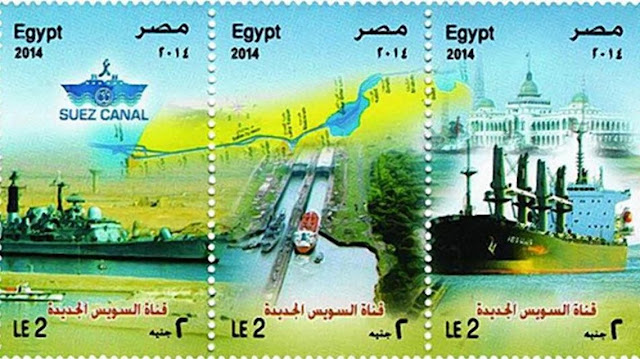
The three stamps, issued August 5th 2014, feature images of a map of the Suez Canal, along with photographs of a waterway in a desert setting which do indeed appear to come from Egypt. The only problem is that the designers seem to have confused their canals. 


The middle stamp shows another two lane waterway in a green, fertile landscape which bears a distinct resemblance to the Panama Canal – the 48 mile Central American passage which links the Atlantic and Pacific Oceans.


Embarrassed authorities announced that they were halting the stamps’ production. Of course the mistake was widely mocked by Egyptians, but for us, it is another amusing anecdote to put a smile on our faces.

They redesigned the issue and released it. Here is the new design:


Print Friendly and PDF

Tuesday, May 5, 2020

Al Quds Day

Here are three stamps with a common denominator.

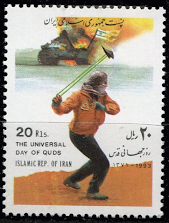
The first stamp, from Iran, was released in Iran for Al Quds Day, during the First Intifada. Intifada is an Arabic word literally meaning, as a noun, "tremor", "shivering", "shuddering". It is derived from an Arabic term nafada meaning "to shake", "shake off", "get rid of". In contemporary Arabic usage, an intifada is a rebellion or uprising, or a resistance movement referring to a legitimate uprising against oppression.

The First Intifada began on the 9th December, 1987. The day before, a driver of a huge truck was driving north on the Gaza highway and allegedly swerved his semi-trailer into the oncoming traffic at the Erez Checkpoint fuel station. The resulting crash involved a car and a truck, both were taking Arab workers back to their homes. 4 Arabs were killed and ten wounded. Rumors circulated that the driver intended to kill Arabs following the death earlier of Shlomo Sakal, an Israeli victim of a terrorist attack. Bocovza denied this claiming that he was trying to turn into the fuel station. The following day riots broke out at the funeral of one of the victims. During the riot, one Arab was killed and many others wounded. As a result, the riots quickly spread throughout Gaza and the West Bank.

What is Al Quds Day, you ask? Well, the Ayatollah Khomeini announced that the last Friday in the month of Ramadan would be recognized as the Day Calling for the Liberation of Jerusalem from the little Satan, that is, Israel.

What can you see in the stamp, an Arab, probably a young man because that's how they sold the Intifada to the world, standing in front of an Israeli tank. You can see the Israeli flag hoisted on the tank. This young man was throwing a stone using a slingshot. Somehow the tank caught fire from the stones.

This Intifada was called the Stone Intifada. The Second Intifada was the Al Aksa Intifada and the Third Intifada was Knives Intifada. It must be clear to everyone that the stone did not cause the tank to catch fire.

The second stamp was issued by Iraq for the Second Intifada, called the Al Aksa Intifada , and the Iraqis called it the Liberation Uprising. This intifada began following Prime Minister Ehud Barak to PLO leader Yassir Arafat and Arafat's refusal to accept it.


Now what can you see in the stamp? Once again we an Arab, but this time it is clear that he is a young man and he is throwing a stone in the direction of a tank, this time without the slingshot. What damage the stone would have done to the tank, I do not know.

What is missing in the stamp? The Al-Aqsa Mosque! The stamp instead shows the Omar Mosque, i.e. the Dome of the Rock. And why? Because with all due respect to the "holiness" of the Al Aqsa Mosque, it is not very eye-catching.

The third stamp completes this short story, and was also issued for the Al Aqsa Intifada. It is a beautiful and very eye catching stamp. A young Arab boy throws a stone at a tank but there is also the Omar Mosque (not al-Aqsa) and a barbed wire fence. The barbed wire fence for Jerusalem is a typical motif in Arab stamps depicting Jerusalem, but this is the first time seen in a stamp from Oman.


The stamp is in black, meaning the color of death. Blood dripping from above. Here the Al Aqsa Intifada is clearly stated. In terms of propaganda I mentioned this in an earlier blog.

So what do they have in common and it is not accidental apart from the fact that they were issued for Intifadas? The Arab propaganda movement wanted to show themselves as the David in front of the Jewish Goliath and they wanted to draw your attention to the equality of their struggle to the struggle of the student in China in Tinaman Square who stood in front of a tank and did not move.


Print Friendly and PDF

Monday, April 20, 2020

Choosing a name for a new country

We are on the eve of Independence Day. A big celebration for us as a country. After over 2000 years, once again we had our own country. It was a great honor when David Ben-Gurion declared independence on 14th May, 1948 at 16:00 at the Israel Museum.

The British mandate was due to expire at midnight on May 15th, the following day, so why did Ben-Gurion hurry to declare independence the day before? And why at 16:00? The answer is simple: May 15th was Saturday and Ben-Gurion wanted to declare independence before the sabbath: both to avoid desecration of Shabbat and so that religious people could be present at the proclamation and return home before Shabbat. It should be remembered that there was a religious party in the People's Administration (Minhelet Ha'am) . Thirteen members of the People's Administration did not sign the Declaration of Independence that day because the siege in Jerusalem prevented them from arriving.

The first stamps of the State of Israel were sent to most post offices before the declaration of independence. It is written on them, "Hebrew Post" and not Israel. Do you know why?

The Jewish leaders knew that the British would leave the country on 15th May, but the official name of the country at the time was "British Mandate for Palestine" or "Palestine" for short. Why Palestine? Because this is the name that the Romans gave to the Judean area after the expulsion of the Jews at the end of the Second Revolt. It's a name that belongs to the whole area. The official name was "Syria Palestine". The historian of the time, Flavius, who was also a Jew himself, said that the reason for calling the area Palestine was to insult the Jews, since Palestine came from the Philistines, the great enemy of the Jews at the time who invaded our area from their home in Crete. The Jews became the Palestinian refugees. The word Jew comes from the word Judea.

Naturally, the Jewish leaders did not want to continue with the name Palestine, which evoked bad associations and memories and did not show our 4000 year to the country, but how to call our country? Several proposals were made, including the name "Judah", which was disqualified because of Judea, which is a small area in the country, and the name "Eretz Israel" was also disqualified. (By the way, I do not have the Judean stamp - it is too expensive for me - I have to pay a mortgage).

 
Who could have known in advance which name would be chosen? The pressure was at its peak. Things had to be done secretly because the British opposed any move and even supported the Arabs and defended them against the Mandate imposed on them. In the mandate agreement signed by the British, they were duty bound to help the Jews establish a Jewish state including building infrastructure and preparing the state for the transition to Jewish sovereignty. History has shown that they did not live up to their part in many cases but that is another story.

So again what do you do? An artist was approached to design the stamp. And it was decided to draw coins of the first and second revolts against the oppressive Roman occupation . The reason was to connect the current period to our history.

But who would understand the message from the design? All you see is a coin, so they decided to attach a tab to the stamp - a practice that continues to this day. By the way, stamps of the series with a full tab in good condition, cost thousands of dollars today, and people still want to buy them, despite popular opinion which claim that stamps are a thing of the past. 

But there are still three problems left: First, what country name to display on the stamp? After all, you have to print the stamps in advance so that they are ready for 16th May, the first official day of the stamps (remember that 15th May was a Shabbat and there are no Jewish post offices open on Shabbat). The second problem, which is no less important - where to print them? They could not use the printing presses of the British authorities nor of the Arab ones. The third problem, how to separate the stamps?


It is important to remember that everything was done in secret because if the British had discovered what was going on, they would have confiscated everything and arrested the criminals. Therefore they outsourced the work to anyone who could do it: Jewish publishing houses, seamstresses, etc. As a result, there are large differences in the color of the paper, the number of perforations (teeth) around the stamp, the separation method and more.

There are entire books just about this stamp. The pair on the right is not an error, this separation method is called roulette and is used to separate  labels, even today.

By the way, because of the pressure, a lot of mistakes were also made, such as the one on the right.

And what about the name? Decided to simply call the stamp "Dar Ivri". They took the idea from the Germans and went with it.

Today, we laugh at the subject of stamp collecting, but it is closely related to our history. It is important to remember and internalize - on Holocaust Remembrance and Heroism Day there is a siren designed to remind all of us what happened when we did not have a Jewish state. On the eve of Memorial Day and Memorial Day there are sirens designed to remind us of the price of maintaining a Jewish state, so that there will be no siren on another Memorial Day.

Print Friendly and PDF

Tuesday, March 10, 2020

From the River to the Sea

 In December, 2017 the Palestinian Authority, now issuing stamps as the State of Palestine, issued a pair of stamps for "Palestine Teacher's Day". The stamp was printed for the Palestinian Authority in the Kingdom of Bahrain.

The stamp depicts a teacher in the colors of the pan Arab flag, pointing to a map of what they call Palestine, meaning no Israel, or "From the River to the Sea". 

The problem with this issue is not the misinformation here, but that a teacher should be teaching this to children. In this frame of mind, where can there be co-existence? 


Statcounter