Showing posts with label Spotlight. Show all posts

Sunday, December 5, 2021

Irish Christmas stamps invoke anger

December 25th, Christmas Day, a time for rejoicing for the entire Christian / Catholic world (some celebrate a week or so later, like in Georigia). Despite being Jewish and not celebrating Christmas, it is nice to see the spirit of Christmas and the many pretty stamps that are issued all over the world.

Ireland innocently brought out a set of stamps, or adhesive labels for Christmas 2021. The set includes four stamps for local postage with the words "Peace and Joy", "Naughty or Nice?", "Ho Ho Ho" and "Sending Hugs" and two stamps for international postage for "Nollaig Shona" (which means Merry Christmas in Gaelic Irish) "Love". It was the local stamps that invoked the ire of the public. Who would have thought that these stamps would have invoked such feelings?

The outrage began with a call to a popular program named Liveline where someone emailed them to pent his frustration at the choice, saying that the stamps used for Irish addresses were secular and didn’t include scenes from Jesus’ birth, such as the Nativity scene or anything that wasn't to his liking.

He made a claim that instead of the Nativity scene, local stamps had phrases such as ‘naughty or nice’, and ‘ho ho ho’. This was actually a part of the problem.


Other callers felt that the phrase ‘naughty or nice’ implies sex and another said that she didn’t want to send a Christmas card to her local priest with a naughty or nice stamp. The phrase ‘ho ho ho’ stamp together with the sexual implication of the naughty stamp concerned people about the possible innuendo.


"The national Christmas stamp range, which supposedly celebrates a major and very ancient Christian festival on December 25, is, as one caller said to Joe Duffy, effectively discriminatory, because if you want a religious stamp you have to pay extra."






Wednesday, October 27, 2021

Video This war is a Jewish War

Second episode. I hope you like it. 

Don’t forget to click like, it is important for me


Thursday, October 14, 2021

My new YouTube Channel

This is my first attempt. I hope you like it.


Monday, September 27, 2021

Cito cito cito

Today we look at a letter and quite often we don't give a thought to how the letter arrived, if we are luck enough for it to arrive. Very often our main mode of communication is WhatsApp or something similar or even an email, although sometimes our mail goes into a spam folder.

But this was not always the case. Are any of you marathon runners? Have you ever given any thought to its origin, and no it is not because of the Olympics; that only started in 1896 at the first Olympics. Well way back before then, there were no computers or smartphones and very often no writing paper or people who could read or write, so what happens if you need to bring news to Athens of an important victory over an invading army of Persians? Well the legend says that in 490BC, an ancient Greek messenger raced from the site of Marathon to Athens, a distance of about 40 kilometers and hence the marathon was born. Personally I don't even feel like driving 40km but I am not a Greek messenger. Apparently after giving the message, the poor exhausted messenger simply collapsed and died.

Legend or not, it shows how important a message is and hence our story of the day. We will fast forward almost 2000 years to the Republic of Venice. The Republic of Venice realized early on that they also need to transfer messages to other cities, in Italy and elsewhere and they allowed for a courier service. Venetians were merchants and traded all over Europe. News regarding prices, goods, merchants and others was very important to get the best deals. The earlier the news arrived, the better the result. This is actually not much different from day, but the Venetian Courier service filled a void!

The service started off as a private service but in the 14th Century, the Great Council decreed that all couriers operating in Venice were subject to the control of their supervisors and also on rates. So the service became an official postal service. I actually have not found any information on the rates but if someone knows, I would be happy to update this post.

So now you employ the service to take a message from Venice to somewhere else, say Verona and you want it to get there quickly, so you pay extra and a notation of "cito" or "haste" is added to your letter. A horse was almost always used in mail but if the mail has the notation of cito, it means the horse must run. I have no idea how long it took the Greek messenger to run 40 km before he died, but Venice to Verona is about 120km, meaning treble the amount and a trot or a run can take ages. So you can pay extra by adding "cito cito cito" would mean fast, fast, fast, in essence no resting and top speed. There is little documentation about this service only in the age of customer service did people realize that you need to document a service so that people can ignore it.

Let's be real, even a horse would not be able to run the 120km at top speed. So if you are in a real hurry, you can can pay for the change of a horse along the way. The drawing of a stirrup on the letter, as on the image on the right, indicates that you are entitled to a change of horse along the way. So you pay for as many changes of horses that you want. An image of three stirrups indicates a change of three other horses along the way.

Now we have couriers carrying important messages throughout Europe and who are the messages of interest to? Your rivals, meaning other merchants. So you need some security, some insurance, right? A hangman's gallows was added to the letter threatening death by hanging to anyone interfering with the mission. I have seen two gallows on a letter, not sure what that would mean, you can't exactly kill someone twice, can you?

The item shown below was sent from the Rectors of Verona (yes, it also worked in the reverse direction) to the Chief of Venice, the Head of the Council of Ten (one of the major governing bodies of the Republic of Venice) in July 1506. The three citos shows maximum speed and the stirrup grants him a horse change alone the way.


For more information see:
  • "Post and Courier Service of Early Modern Italy" ~ Postal History Journal No 055
  • "The Cito Mark Part I" ~ American Philatelist Vol 069 No 06, March 1956
  • "The Cito Mark Part II" ~ American Philatelist Vol 069 No 07, April 1956


Print Friendly and PDF

Monday, August 30, 2021

Story of Ceska Trebova

I was preparing a page for my exhibit and trying to think of what to use and I cam across the stamp on the right. The stamp shows the coat of arms of a Czech town called Česká Třebová situated on the border of Bohemia and Moravia.

According to the information sent to me by their webmaster, the name of the town is based on the old Czech word triebiti meaning chop down because at that time the entire area was covered with forests which needed to be cleared before settling there. The town received the addition of Česká so as to distinguish itself from other areas named Třebová.

Enough of that, let us look at the coat of arms. During history Česká Třebová was a town of potters, weavers and peasants. A simple clerk took care of the town's official seal. Not sure why but he pledged his life for its safety and guarded it very carefully. Unfortunately for him and despite his best efforts, the seal disappeared. Both he and his wife searched everywhere for it, his life was at stake. But it was no where to be found.

The poor guy was arrested and put in jail. He was able to watch in despair  as the carpenters build the gallows where he would be hanged. They took this very seriously. His faithful wife continued the search but with little hope. She looked out the window and saw a rooster standing in the yard, clutching something under its claws. Running out she found that the bird had the seal in his claws and she managed to rescue her husband at the very last moment. To commemorate this event they changed the coat of arms to be a rooster with a human head.

Now we get to the human head which is what caught my eye in the first place. Throughout medieval Europe, there were many anti Jewish laws in place. Jews seemed to be the scapegoats for anything including the Black Death. Anything bad happened, blame the Jews. Today it is blame Israel, same thing but off topic.

So now the question was, how to identify who is Jewish so that people can decide whether they want to do business with them or not. The Nazis used a yellow badge in the form of a star of David. In ancient times it was a piece of clothing. In German-speaking Europe, as early as mid 13th century, there was a requirement for Jews to wear a Judenhut which was a cone-shaped hat, such as the one in the Česká Třebová coat of arms! On the left you can see similar hats. Check this for more information on the Jewish star.

The coat of arms of Judenburg in Austria also has the head of a Jew wearing the funny hat. Now the question is why were the Jews of this small town in the Czech area subjected to wear this hat. According to their museum this was not intended as a symbol of anti-Semitism. Jews were among the most educated sections of their society as they were one of the very few who could read and write. This was custom dress for a Jew. They claim that it was a sign of respect.

Maybe that is what they believed then, thoughts?


Print Friendly and PDF

Sunday, August 15, 2021

What is a Bishop Mark

What travels around the world but remains in a corner? A postage stamp and its postmark, of course. Today we receive a letter in the mail and we look at the postmark and see when it was posted and why it took so long to get here. But as with the postage stamp, this practice had to have been started somewhere, some how, even though today we take it for granted.

In 1660, Henry Bishop was made Postmaster General of England. This was actually a new position. He had previously had issues with the English royalty and his estate was taken away from him, but all was forgiven and he took the new post of Postmaster General.

At the time there were many complaints of delays in the post, just like today, but unlike today when the cancel clearly shows the date sent, at that time there was no such indication. Henry decided to do something about it.

The first type of British postmark was introduced the following year, in 1661, at the London Chief Office. Henry claimed:

"A stamp is invented, that is putt upon every letter shewing the day of the moneth that every letter comes to this office, so that no letter Carryer may dare to detayne a letter from post to post; which, before, was usual." ~Mercurius Publicus


Translated into simple English, the Bishop Mark, as it became known, was a stamp (a cancel) displaying the day and month of any letter that passed through the post office, meaning letters sent and letters received.

At first the mark was only used in London, usually in black ink and placed on the back of the letter. The original London Bishop Mark consisted of a small circle, bisected horizontally, with the month abbreviated to two letters, in the upper half and the day of the month in the lower half. Initially it was common practice to use the letter “I” instead of a “J” so that affected January, June and July.
  • January ☞ IA
  • February ☞ FE
  • March ☞ MA (also seen as MR)
  • April ☞ AP
  • May ☞ MA
  • June ☞ IV (to differentiate with July)
  • July ☞ IU (also seen as IY)
  • August ☞ AU
  • September ☞ SE
  • October ☞ OC
  • November ☞ NO
  • December  ☞ DE

During the 18th Century the format was changed and the month was displayed in the lower half.

1780 Wrapper sent from Ely with London 29/NO Bishop Mark for 29 November

As the Bishop Mark was also intended for incoming mail, the Foreign section of the General Post introduced a Bishop Mark in 1684. This was different from the English (London) Bishop Mark in that the month was in the lower half.

The use of the Bishop Mark soon spread to Dublin, (Ireland) and then to Edinburgh, (Scotland). When the Scottish Post began to implement the Bishop Mark, they placed the month in the lower part and were known to also use red cancels.

In exhibiting, in Thematics, Bishop Marks open up an opportunity as there is no year displayed. So when you need to refer to a day in the year which happens every year, you can use a cool pre-philatelic item with a Bishop Mark. As an example if you want to talk about Christmas Day, you can have a Bishop Mark of 25 December.

Henry is credited as being the inventor of the first postmark used on mail. Strangely he was only in office until 1663. The design of the Bishop Mark did change over the centuries and I am not going to list them. This is just an introduction for those who have never heard of it. Thank you Henry.


Print Friendly and PDF

Stopping the Iranian nuclear bomb

It should come as no secret to anyone that Iran was trying to build a nuclear bomb, with the means to deliver the bomb and the first target would be Israel. In 2005, the Iranian president, Mahmoud Ahmadinejad, boldly proclaimed that Israel "should be wiped off the face of the earth".

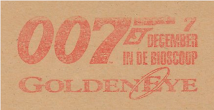
Sounds like a story out of a James Bond movie, when a fanatic gets their hands on a weapon of mass destruction and 007 is sent to save the day, but it isn't. 007 is not real, or is he? It is also no secret that Israel really doesn't want to be the victim of a weapon like this.

Along comes Mohsen Fakhrizadeh Mahabadi, born in 1958, a brigadier general in the Islamic Revolutionary Guard Corps. However Mahabadi was also a physicist, and a senior member of Iran's nuclear program. 

He taught physics at Imam Hussein University in Tehran. A 2007 United Nations Security Council resolution identified him as a senior scientist at the Ministry of Defense and Logistics of the Armed Forces and the former head of the Physics Research Center (PHRC) in Lavizan-Shian. He was the leader of Project AMAD, Iran's Nuclear Program, as well as the Defensive Research and Innovation Organization in his country.

On November 27, 2020 Mahabadi was ambushed while traveling in a black Nissan Teana on a rural road in Absard, a city near Tehran. Iran's foreign minister, suggested that Israel was behind Fakhrizadeh's assassination. It is always easy to blame the Mossad as they would be the logical suspects here. However there are so many differing accounts of the assassination emanating from Iran so the actual details are irrelevant for the purpose of this blog.

On December 15th, the national postal operator released the draft of a postage stamp in Fakhrizadeh's honor.


The stamp, as we can see, is decorated with the image of the Martyr Fakhrizadeh, the flag of Iran, mathematical and chemical formulas, as well as a bullet mark, which is a symbol of terror and martyrdom.

As far as the formulas are concerned, given their apparent inaccuracy, they provoked protests and reactions from several people in cyberspace. In response the President of the Stamp Council, said: 

"The purpose of writing the formula on the image drawn on Fakhrizadeh's stamp was to show the scientific position of this great martyr and it is not intended to use these formulas scientifically."


The final stamp was issued in May 2021 but the design was slightly different. For example, the background formulas were no longer displayed. However, one significant element was still very prominent, located in the lower right corner: the effect of shattered glass by a bullet.

Article reproduced with permission from: https://www.filatelista-tematico-blog

Print Friendly and PDF

Saturday, July 31, 2021

Younger collectors are here

People who say that stamp collectors are all old people, or middle aged people, are unaware of the newcomers who have YouTube channels. Graham Beck of Exploring Stamps has pointed out one to us and the Digital Philatelist (Digi) brought another to our attention. I want to spotlight them here.

A young stamp collector who understands what philately is all about, and just started making their YouTube channel "I'll Be Stamped!" He doesn't give his name, but check it out.


Another one I would like you to check out, is Lisa at "StampCat Stamps". She says "Exploring my postage stamp collection one stamp at a time." Check out this video, filled with history that some I did not know and others I forgot about.


If you know of others, let me know.

Wednesday, June 30, 2021

Latvia declares independence

Let us look back, further back than we have before in this blog and return to 1914. It was a great period, one of modern technology, culture and fashion. Truly the height of civilization, so let's have a war.

Everyone knew a big war was coming. France wanted some stuff back that Germany had taken from it. Germany wanted to take more of everyone stuff and they were building the means to do so. Everyone had alliances with everyone else and people were just itching for a war and so it happened. The Great War to end all wars, but of course it wasn’t.

After four long brutal years, the war ends and as victors do, they start dishing out the spoils and in this case, creating new countries. One of the lucky ones was Latvia. In the aftermath of World War I, she declared independence from Russia but did Russia agree? Soviet troops were occupying Latvian territory as fast as German troops were withdrawing from it. This created shortages.

So now Latvia believes that they are an independent country and what is the first thing a new independent country must do? Issue stamps. OK, not the first thing but important enough anyway. Issuing stamps showing your own culture, heritage, customs and identity are a key part of a country's claim of independence; stamps are a symbol. So they placed an order for the printing of three million postage stamps.

"Houston we have a problem", there is a shortage of everything, including paper. How are they going to print millions of stamps?

Well the retreating Germans were not able to take everything with them and one of the things they abandoned were large numbers of unfinished maps which were stored in their Riga headquarters. There were so many that they were even being used in the Riga market to wrap fish. English fish and chips, anyone? OK not the fried kind anyway.

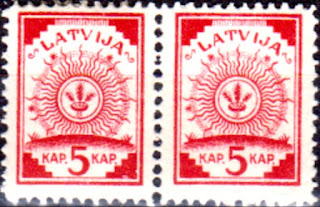
Now these maps were unfinished. The map side of these foldable maps was finished, but their backs, which were to show the region name, scale, etc., were not yet printed. They hadn’t been folded yet, so they were nice and flat and just waiting for someone to decide what to do with them that did not involve fish. The idea was to just turn them over and print the stamps on the other side.

The military maps on the back of these stamps, which are often upside down versus the stamp design, are usually printed in brown and black on dark cream gummed paper. Some were perforated and some imperforate, so you'll find both out there. You can find them with a blank backing, a simple line or an intense display of topography. Finding them on cover is far less common as the stamps were in use for a very short while.

Even though these map stamps have never been rare or expensive, there are forgeries out there, please don't ask me why so I won't have to lie to you.

Unfortunately the Latvians did not get their independence without a fight, and soon after declaring independence the Russians captured Riga, the capital city, and now we have a conflict involving the Soviets, the Latvian army, the Germans, as if World War One was not complicated enough. All's well that ends well as they were granted their independence two years later. The victors of World War One granted her independence.

This lasted until the second war to end all wars.

Print Friendly and PDF

Tuesday, May 11, 2021

Spotlight - My WOW item - an item from the Spanish Inquisition

As exhibitors and collectors we are always after that WOW item, the item that you have been looking for, or the item that you saw and think wow, why didn’t I think of that before. As collectors, it is nice if others look at the item and also say, wow. It is not even a case of money since not every wow item is expensive. For me, I had not really found an item like that in some time.

While in Verona in November 2019, at the ECTP 2019 exhibition, in which I won the Champion of Champion class (hey if I don't blow my own trumpet, who will), I saw an exhibit on Columbus. I discussed with a friend to and we decided to see how the exhibitor approached the issue of Queen Isabella of Spain. I wanted to improve my page about Jews not being wanted.

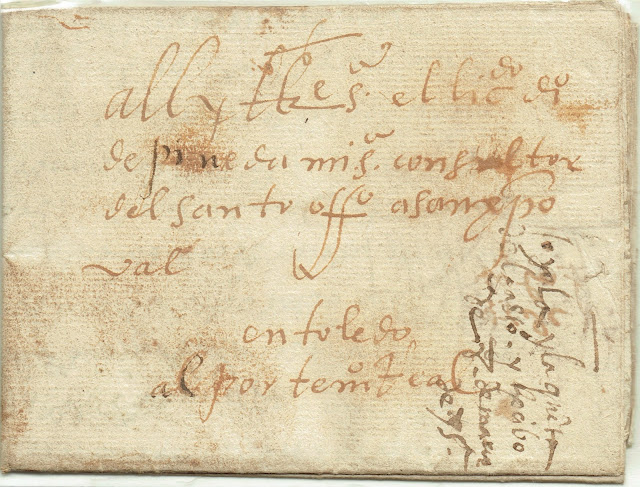
We thought that there may be covers of some kind, sent by Queen Isabella, and then we saw it, the WOW item. It was a cover sent to Friar Diego Pineda of Toledo in 1582. Friar Diego Pineda was an official consultant to the Santo Oficio a San Cristóbal or the Holy Office of the Inquisition. We never even considered this direction.

We will not go into the history of the Inquisition as many of us already know it; the history is not new to us. Just to make it short, the Spanish Inquisition was established in 1478 by Catholic Monarchs Ferdinand II of Aragon and Isabella I of Castile. It was intended to maintain Catholic orthodoxy in their kingdom and to replace the Medieval Inquisition, which was under Papal control.

Basically they said "its our way or the highway" meaning either convert, be killed or leave.

The full name of the Inquisition was Santo Oficio de la Romana y Universal Inquisicion or “Holy Work of the Roman and Universal Inquisition". Santo Oficio means “Holy Job or Work”. Since the name was actually Holy Work of the Roman and Universal Inquisition, it was shortened to el Santo Oficio which was a far more used name for the institution than Inquisition, which was the preferred term of Anglophile countries, most likely because for Protestants, Holy Work sounds too good for the evil abhorrent Catholic tribunal.

The tribunal in Toledo was established in 1485 and the Inquisitor General there presided over the court in the Church of San Cristobal. As yet I have not been able to find information about the consultant just that his full name was Friar Diego Pineda.

The story of the inquisition fits my story perfectly. Now I really needed an item of my own. I approached the exhibitor who put me in touch with a site. I did a search there and found the cover he originally purchased and amazingly found a second item which I immediately purchased.

The cover eventually arrived and it is quite similar. It was also sent from Madrid to Toledo, again to Friar Pineda. Sent 8th March, 1575, and postage paid was ½Real.


Let us get a tad boring for a moment while I explain something. Up until 1580, the mail service within Spain was for the service of kings and nobility. Sending a letter or official documents at this time was very expensive because you had to pay the service of the postman, the benefit of the postmaster, the accommodation and the maintenance of the mail during the route, the food for the horse and others. If the king sent a letter from Madrid to Toledo, the postage rate was 100 Reals. Some private individuals also gave the postman their private correspondence and only paid a token amount of ½ Real, which is what my letter was charged. By doing this, the courier could not ask Friar Diego to pay up.

Now according to exhibiting rules, the name of the recipient does not enable us to use an item, unless the recipient had special postal privileges, in this case the full postage was paid. Does this make it illegitimate? According to the new SREV for thematic, this is considered borderline. It is legitimate because it is the best item to use to display the thematic point, the inquisition.

I now have a WOW item in my exhibit.

Note: This article was previously published in the Israeli Thematic Bulletin and the British THematic bulletin

Print Friendly and PDF

Wednesday, April 28, 2021

Spotlight - Forced to work as a consultant

Hi everyone, welcome back.

I have just sold an interesting cover that I purchased last century for a lot of money and sold it again for a little bit of money. Perhaps I could have sold it for a bit more but I wanted to buy something else and that is the name of the game.

I want to tell you about this item as it is a true piece of history, a piece showing the face of antisemitism, before the Holocaust.

As we all know, the Nazi Party rose to power in 1933 and immediately began issuing many anti Jewish (and others of course) regulations. The underlying idea was to remove non Aryans, mainly Jews, from public life. This became known as the Reich Citizenship Law.

The Fifth Ordinance of the Reich Citizenship Law of 27 September 1938 removed all Jewish lawyers from the bar. They were only allowed to work as consultants to provide legal advice to Jewish clients, Dr Berl Cooper was one such Consultant.

Only 10% of licensed Jewish lawyers were allowed to work as consultants.


Print Friendly and PDF

Tuesday, February 2, 2021

Spotlight - a surprising cover from UNRWAPR

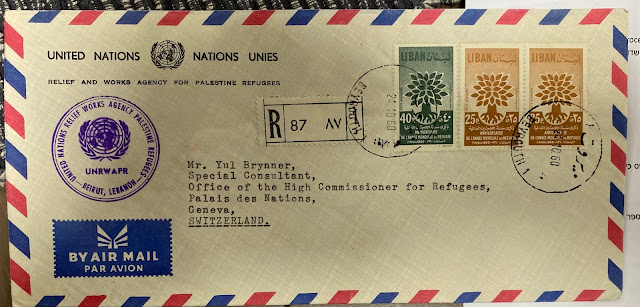
I recently began to build a one-frame exhibit on the Palestinian refugee problem. While searching for material for this exhibit I came across a sale of the cover shown below. On the front is a private cancel (not a postmark) in purple for "The United Nations Relief and Works Agency for Palestine Refugees". The initials of this organization are UNRWAPR, but most of us are mostly familiar with the abbreviated acronym UNRWA. However this was the initial name.

When the letter arrived I first noticed the name of the recipient, and I realized that there is an interesting story here. The letter was sent in October 1960 from the UNRWA agency in Beirut by registered mail, and it carries the International Refugee Year Stamps. The letter was sent to Mr. Yul Brynner, Special Adviser to the UN High Commissioner for Refugees in Geneva.


The High Commissioner for Refugee Affairs is an office established in 1950 in order to assist refugees all over the world to integrate in the countries in which they reside. This commission, which has its hands full of work to this day, has also twice won the Nobel Peace Prize, in 1954 and 1981. Because Arab states opposed the integration of Palestinian refugees into their states, it was decided on the establishment of a separate body - UNRWA - that dealt exclusively with Palestinian refugees.

I guess we all remember film and theater actor Yul Brinner, mostly because of his unforgettable performance as King Mongkut of Siam in the musical "The King and I" on Broadway stages and on the movie screen, for which he even won the 1956 Academy Award. Brynner died in 1985, at the age of only 65, from lung cancer because he was a heavy smoker. In the last months of his life he joined a campaign by the American War Association that called on the public to quit smoking.

A brief examination I conducted revealed that in 1959 Brynner was appointed special adviser to the High Commissioner Of the United Nations Office for Refugees. 1960 was declared International Refugee Year, and Brynner used his status as an international superstar and was interviewed by media all over the world to highlight the plight of millions of refugees.

It turns out that Brinner was also an amateur philatelist.

An American friend showed me two more Yul Brynner covers related to the United Nations. One is shown here as it is also related to refugees. These covers seem to be philatelic in nature, and it is doubtful that they were actually sent. It is clear that Brynner collected such items, presumably to keep a souvenir for himself from his time as a "special adviser."


This was originally published in a Hebrew language two monthly newsletter, NosonNet, and was translated from that newsletter

Monday, January 13, 2020

A cool stamp from Oman

My favorite stamp collecting theme is Arab philatelic propaganda against Israel and there is a lot of material out there. I have shown some of the items on this blog. I have provided many lectures on this issue and written many articles.

Today I would like to highlight one specific stamp, because it shows the issue quite vividly. I have spoken about this stamp briefly but one of my readers asked for it in more details.


The stamp (souvenir sheet) was issued by Oman in 2001 for the Al Aqsa Uprising, commonly known as the Second Intifada. An Intifada is an Arabic word for an uprising of the people. The white Arabic writing on the right says Intifada.

We see a child throwing a rock at a tank, which is presumably an Israeli tank as this took place in Israel. The mosque on the right, is not the Al Aksa Mosque but the Dome of the Rock. The Al Aksa Mosque is a few hundred meters away. This is actually a common error in the news when they display this mosque. Check this out: Oh Malaysia.

Having been to Jerusalem many times, I can honestly tell you that there is no way that a tank can get to the Temple Mount, unless it was dismantled and carried piece by piece up and put back together. Before they managed to do this, they would have been lynched. No Israeli government would allow that. But let us assume that this is for graphical effect (Propaganda effect), it does get the point across. The boy throwing the rock at the tank is another propaganda issues. A rock thrown at a tank will not even dent the armor, that is why there is armor. The point of this image is merely to bring back memories of the 1988 Chinese Tiananmen Square issue.

The background of the stamp is black and that is the symbol of death! We see barbed wire in red, the color of blood, which is new but the barbed wire is a common motif in Arab stamps depicting Jerusalem, it is to symbolize that Jerusalem is a prisoner and must be liberated. This imagery was sparked by Iran when they nominated the last Friday of Ramadan as the day for liberation of Israel.

But the past part is the blood dripping from the top. Not sure how that fits into the point that the Oman designer was trying to get across unless he was trying to say that a lot of blood was spilled. But it really adds to the beautiful gruesomeness of this issue.

This stamp is in my collection, but not in my exhibit, yet it is one of my favorite stamps. ..

Statcounter