Showing posts with label British Mandate. Show all posts

Sunday, June 25, 2023

Throw away or keep?

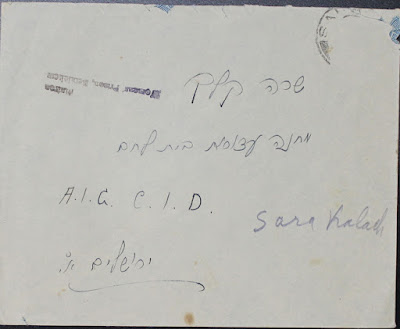
We as stamp collectors deal with stamps, that is why we are known as stamp collectors. As children and many adults, when we get a letter, we tend to remove the stamp from the envelope and put the stamp in our albums and that's it. So what happens when we find a letter like this? As a stamp collector, this letter seemingly has no value. It's missing a stamp. But wait, is it really worthless or should we look into it further?

This letter was written to a woman by the name of Sarah Kalach. Sarah was born in 1928 in Safed and she belonged to a very, very, very old Safed family. They probably got to Safed after the Arab massacre of the Jews of Safed in 1834 which began on June 15th, yes 189 years ago.

As a child, Sarah joined the Etzel movement. Etzel stands for "Irgun Tzvai Leumi" (IZL) which translates to "The National Military Organization in the Land of Israel". As we all know, the British were in control of what was then called the British Mandate for Palestine and the the IZL organization was labeled a terrorist organization by them.
Guerrilla warfare are actions taken against basically military targets, while terrorism is practiced against civilian targets.
That means that Sarah basically belong to a terrorist organization as far as the British were concerned, so her days as a free person were numbered. Sarah was living in Haifa and she got word that the British authorities were looking for her. So she moved to Tel Aviv and after about the year she moved back to Haifa to take care of the branch since many of her colleagues had already been taken prisoner.

In June of 1946 the IZL took part in the King David hotel bombing. The British obviously saw that as a terrorist act, but the IZL group claimed that it was a legitimate target because that was the the British Army Headquarters. Now after this, the British started to crack down big time on the IZL members. As as I said before, Sarah was living in Haifa and somebody spilled the beans and informed the British CID, the Criminal Investigation Department. Heinz Reinhold snitched on her to the CID and he actually told them exactly where to find Sarah.
Sara Kalach, is on the left
On the 29th of October 1946, the British authorities raided the apartment and took her and her brother Shlomo into captivity. Shlomo was actually expelled to Africa, to a detention camp in Kenya. He remained there until after Israeli independence had been declared.

Sarah was sent to the Woman's Detention Camp in Bethlehem and this letter was sent while she was imprisoned there. She was released in March of 1948, along with other woman prisoners, not long before the British left Palestine. Don't worry about her. She got married in 1952 and now has children and grandchildren.

Back to the letter. It was written to Sarah in 1947 when she was in the detention camp, and it was written to her, by her father, Yakov, or they also called him Yankele. The British CID removed the stamp. Why? Because they suspected that messages were written on the back of the stamp. This practice had been in use by the British themselves during the Second World War, So they were aware of the system and they were making sure that messages sent to Sarah didn't bypass the censor of the censor.

And that's the story. Take a simple letter, which you know nothing about, that most people would throw away. I would have, if I didn't know history. This is a lovely case of social postal history.


Print Friendly and PDF

Tuesday, September 7, 2021

An armored car stamp

We recently spoke about the Israeli interim period in which the British had not yet left, but were still playing games with us and one of those games was interefering with the transfer of mail. I wrote two posts about this, one "When a label is not a label" and the other "Whiskey Mail". Here comes another in this fascinating period in our postal history.

The story is about a city called Rishon Lezion. I would not want to live there but I am in the minority because it is among the largest cities in the Israel currently one about a quarter of a million inhabitants. I know that is small by most countries standards but we are a small country, about the size of New Jersey in the USA. For us Rishon as it is known, is so large that it is sometimes difficult to distinguish its border and the neighboring town known as Holon.

But Rishon Lezion was not always so big. In 1882 about 10 pioneers together purchased about four acres of land to establish the city. The city grew, of course, and other cities were established around it, such as Tel Aviv, Holon, and a city called Nahalat Yehuda, north of Rishon, which today is part of Rishon Lezion itself. However in 1948, Rishon Lezion had about 12,000 inhabitants, 5% of its size today. In those days between Rishon Lezion and Tel Aviv there were orange groves, sand dunes and two hostile Arab villages, Beit Dajan and Yazor.

Remember the post about Safed and the problems it experienced in 1948? The Whiskey mail post? Not only Safed suffered, there were battles all over the country and of course the British, like today, did nothing to protect the Jewish inhabitants. The Arabs from the villages around Rishon Lezion began attacking Jewish vehicles traveling between Rishon and Tel Aviv. Shots, stones and ambushes were daily occurrences and as you can imagine it was exactly a pleasant time.

Some citizens took an initiative and made home-made armored vehicles. Basically they took a bus and added steel to it, and the buses accompanied the cars that were on the road. Until in one ambush seven people were killed near Yazur and all traffic to Tel Aviv was stopped

Like today, Tel Aviv at that time was the center of business (not our capital), trade, post office, supplies, etc. and people had to get there and back. They had to find a way to get there and they did. They found a way that passed through fields, dirt roads to Holon and from there to Tel Aviv. Instead of 20 minutes to get to Tel Aviv, it just took about two hours. Something I learned from spy movies, is that a route must be changed so that no one could study and ambush them. So the drivers did that, especially taxi drivers, every day they found a different way between the fields, the main thing that the belligerent Arab units would not learn the route.

Contact with Tel Aviv was also problematic. There were no phones to speak of and the official mail services of the Mandate were not regular, only once or twice a week, and people need to be in contact.

Here's a thought. If there are cars making trips back and forth, why can they not take and fetch mail? So the local council convened and decided to set up its own postal services. Of course it was not legal because there was supposedly still the Mandatory Postal Service, so as always happens, they decided to set up a committee to deal with the issue and make sure that the committee had no connection to the local council, wink wink.

The committee convened and decided on the design of a stamp for the service, a stamp showing the armored vehicle that was in service from Rishon LeZion to Tel Aviv. Since this was a local postal service of Rishon LeZion, the service started in only one direction, from Rishon. 

What is amazing here, is that from the moment of approval, stamp design, stamp printing until the moment the first letters came out, only eight days passed. All this in an emergency when surrounded by hostile villages. Which committee would have been successful today where most committees decide not to decide, especially if it is the UN.

The service operated similarly to a courier service. Someone who needed to post a letter would buy stamps at high prices (someone had to finance the service) and bring the stamped letter to a specific restaurant in Rishon Lezion. A courier would collect the letters at eight in the morning and travel to Tel Aviv with an armored taxi. In Tel Aviv, he would take the stamped letters to recipients and return home.

As soon as people saw that the service was successful, neighboring Nahalat Yehuda also joined the service. Of course Tel Aviv merchants also joined in and the same courier would collect the mail from an agreed collection point in Tel Aviv and would return with the mail.

The service operated for about a month and was stopped on May 6th when the postal services of the People's Administration went into operation.

Of course collectors and stamp dealers liked the service and saw potential and they also sent letters as curiosities, but that is life.

Sold in "Tel Aviv Stamps" auction in February 2021


Print Friendly and PDF

Tuesday, December 29, 2020

E.E.F. Stamps

Our story began 100 years ago when as you know, in 1917, during WW1, a British General named Edmund Allenby, managed to drive out the last Turkish occupation forces from our area, thus ending 400 years of occupation. He commanded a military force known as the Egyptian Expeditionary Force or EEF; remember that name because we will get back to it soon. The force was established the previous year, specifically for the invasion of Sinai and Palestine.

We will not go into various historical details but we will talk about interesting aspect. With the Turks out, the British became the new occupiers and both soldiers and civilians were living in the Holy Land, and of course people wanted to send messages out. Since there were no emails in 1917, they had to write letters. But they had no stamps; the Turks had been driven out. So what were they going to do? Simple, use the stamps already used by the armed forces, the EEF stamps. These stamps were in use since the establishment of the force. After the League of Nations gave the British the mandate to prepare our area for the Jewish state, General Allenby transferred the administration to the representative of the British government, the High Commissioner to Palestine, Lord Herbert Samuel. Lord Herbert Samuel arrived in Palestine in 1920, that is, a hundred years ago.

Now things are starting to get complicated. Herbert Samuel saw that there was no indication on the stamps to show that the letter had been sent from Palestine and that, of course, was inappropriate. So he decided to add on overprint on the stamp itself.
After consultations, Herbert Samuel decided that the overprint would be in three languages, Hebrew, English and Arabic! The word Palestine in three languages! Houston, we have a problem, the Jews wanted the Land of Israel to be used and not Palestine, their claim was that the territory was promised to them, not only in the Balfour Declaration but also in the San Remo Agreement. The Arabs objected because it was a political statement. 

Resentment rose, not only with the British but also with the Jews. The British did not like the squabbling and said that the League of Nations named the area Palestine, and when the Jews become the masters, they can call the area whatever they want. So they agreed to a compromise, "Eretz Israel Palestine". Of course, if you add all that text on an overprint, it becomes very crowded and illegible and therefore they reached another compromise “EI Palestine”. 

Again the Jews accepted the compromise and stamps were printed as tests; actually these stamps are quite rare. The local Arab residents disagreed believing that this was still a political statement and they rioted, violently. The British immediately caved in and offered another compromise, “Palestine EI”. This was a good indication to the Arab inhabitants and they realized that riots were a weapon for everything. You don’t get what you want, violent riots, BLM anyone?

Now the million dollar question is which language should be at the top and which at the bottom. Herbert Samuel decided that English would be in the middle to separate the squabbling kids, but still which language would be at the top, Arabic or Hebrew? After a struggle, the Jews gave up and Arabic was printed at the top. During printing, several errors occurred and the overprint was shifted upwards, so you can find examples in which Hebrew is at the top. An example of a stamp with an error appears on the right.

They started printing the overprint on the stamps and residents started sending out letters, and all of a sudden they noticed a problem. OMG, the word Palestine in Arabic(فلسطين) is smaller than the word Palestine EI. What? Couldn’t they notice this during the previous riots? They only now noticed this? The fact is that yes, they were so angry about where to put the Hebrew that they did not notice that in essence the name in Arabic is less prominent (example of a stamp on the right). So how do you respond to this problem? Riots!! After all, everyone knows that if you do not riot, the media does not care and if the media doesn’t care, it does not exist. 


So what did the British decide to do? Very simple, increase the font of the word Arabic word. So after a few months, the entire inventory of the first overprint was withdrawn from all post offices and a new overprint was introduced. After a few months, the stock of stamps ran out and it was reprinted again but with slight difference. Due to the difference in prints, they received official names such as Jerusalem I, Jerusalem II, and Jerusalem III. Very original, I know, but it came from the company printing the overprints and the company that had the job was the Greek Orthodox monastery in Jerusalem.

It was then decided that the overprints would be printed in the same printing house as other stamps of the British Empire, meaning in London. In the book by Nabil Shaath, yes the same one who was once involved in negotiations with Israel, he wrote that the reason it was moved to London was due to pressure from the Zionists to take jobs from an Arab printing house. Is a Greek monastery considered to be Arab? Not sure, but Archbishop Capucci belonged to the same church and if you don’t know who he is, then stay tuned for another story in the future.
Does the story end here? It's a good place to end but unfortunately it doesn’t. Why unfortunately and here we have an historical distortion. In 2018 the Palestinian Authority, which had decided to issue stamps with the name, the State of Palestine, issued a stamp for "100 years since the first Palestinian stamp" and the stamp depicted the high value of the original EEF stamp. And here's the issue, in the official declaration of the issue and the First Day Cover, instead of the correct interpretation of the letters EEF, they called it Education, Endowment and Foundation, the same letters but changed them without any historical basis. And in which printing house were the stamps printed? The official printing company of Bahrain, our new buddies. A little birdie told me that the Palestinian Authority was so angry with Bahrain as a result of their peace agreement with us that they demanded that the PA stamps would no longer be printed in Bahrain, but at a local printing house. They were getting the printing for free, now you are going to pay for it.

Going back to the matter of distorting historical information and you're probably asking, as I was asked, who cares? Distortions in stamp catalogs and articles refer to stamps as a historical tool. So you're probably asking yourself again who cares and if so, I suggest you read George Orwell's "1984" book.

Every record has been destroyed or falsified, every book rewritten, every picture has been repainted, every statue and street building has been renamed, every date has been altered. And the process is continuing day by day and minute by minute. History has stopped.

Print Friendly and PDF

Monday, April 20, 2020

Choosing a name for a new country

We are on the eve of Independence Day. A big celebration for us as a country. After over 2000 years, once again we had our own country. It was a great honor when David Ben-Gurion declared independence on 14th May, 1948 at 16:00 at the Israel Museum.

The British mandate was due to expire at midnight on May 15th, the following day, so why did Ben-Gurion hurry to declare independence the day before? And why at 16:00? The answer is simple: May 15th was Saturday and Ben-Gurion wanted to declare independence before the sabbath: both to avoid desecration of Shabbat and so that religious people could be present at the proclamation and return home before Shabbat. It should be remembered that there was a religious party in the People's Administration (Minhelet Ha'am) . Thirteen members of the People's Administration did not sign the Declaration of Independence that day because the siege in Jerusalem prevented them from arriving.

The first stamps of the State of Israel were sent to most post offices before the declaration of independence. It is written on them, "Hebrew Post" and not Israel. Do you know why?

The Jewish leaders knew that the British would leave the country on 15th May, but the official name of the country at the time was "British Mandate for Palestine" or "Palestine" for short. Why Palestine? Because this is the name that the Romans gave to the Judean area after the expulsion of the Jews at the end of the Second Revolt. It's a name that belongs to the whole area. The official name was "Syria Palestine". The historian of the time, Flavius, who was also a Jew himself, said that the reason for calling the area Palestine was to insult the Jews, since Palestine came from the Philistines, the great enemy of the Jews at the time who invaded our area from their home in Crete. The Jews became the Palestinian refugees. The word Jew comes from the word Judea.

Naturally, the Jewish leaders did not want to continue with the name Palestine, which evoked bad associations and memories and did not show our 4000 year to the country, but how to call our country? Several proposals were made, including the name "Judah", which was disqualified because of Judea, which is a small area in the country, and the name "Eretz Israel" was also disqualified. (By the way, I do not have the Judean stamp - it is too expensive for me - I have to pay a mortgage).

 
Who could have known in advance which name would be chosen? The pressure was at its peak. Things had to be done secretly because the British opposed any move and even supported the Arabs and defended them against the Mandate imposed on them. In the mandate agreement signed by the British, they were duty bound to help the Jews establish a Jewish state including building infrastructure and preparing the state for the transition to Jewish sovereignty. History has shown that they did not live up to their part in many cases but that is another story.

So again what do you do? An artist was approached to design the stamp. And it was decided to draw coins of the first and second revolts against the oppressive Roman occupation . The reason was to connect the current period to our history.

But who would understand the message from the design? All you see is a coin, so they decided to attach a tab to the stamp - a practice that continues to this day. By the way, stamps of the series with a full tab in good condition, cost thousands of dollars today, and people still want to buy them, despite popular opinion which claim that stamps are a thing of the past. 

But there are still three problems left: First, what country name to display on the stamp? After all, you have to print the stamps in advance so that they are ready for 16th May, the first official day of the stamps (remember that 15th May was a Shabbat and there are no Jewish post offices open on Shabbat). The second problem, which is no less important - where to print them? They could not use the printing presses of the British authorities nor of the Arab ones. The third problem, how to separate the stamps?


It is important to remember that everything was done in secret because if the British had discovered what was going on, they would have confiscated everything and arrested the criminals. Therefore they outsourced the work to anyone who could do it: Jewish publishing houses, seamstresses, etc. As a result, there are large differences in the color of the paper, the number of perforations (teeth) around the stamp, the separation method and more.

There are entire books just about this stamp. The pair on the right is not an error, this separation method is called roulette and is used to separate  labels, even today.

By the way, because of the pressure, a lot of mistakes were also made, such as the one on the right.

And what about the name? Decided to simply call the stamp "Dar Ivri". They took the idea from the Germans and went with it.

Today, we laugh at the subject of stamp collecting, but it is closely related to our history. It is important to remember and internalize - on Holocaust Remembrance and Heroism Day there is a siren designed to remind all of us what happened when we did not have a Jewish state. On the eve of Memorial Day and Memorial Day there are sirens designed to remind us of the price of maintaining a Jewish state, so that there will be no siren on another Memorial Day.

Print Friendly and PDF

Statcounter