Showing posts with label no communication. Show all posts

Monday, October 24, 2022

Undercover mail from Iran

Israel always had good relations with Iran during the regime of the Shah. Iran was one of the few Middle Eastern countries that had any relations with Israel. Mail passed freely between the two countries. When the Ayatollah Khomeini took power in 1979, mail from and to Israel was no longer handled. Mail to Iran was stopped in 1983. Mail from Iran addressed to Israel was returned to sender and received an instructional marking of "There is no postal relations between Iran and Israel". Israel was suddenly cut off from Iran. Note: The actual message was: "Thereis no postal relations between Iranand Israel".
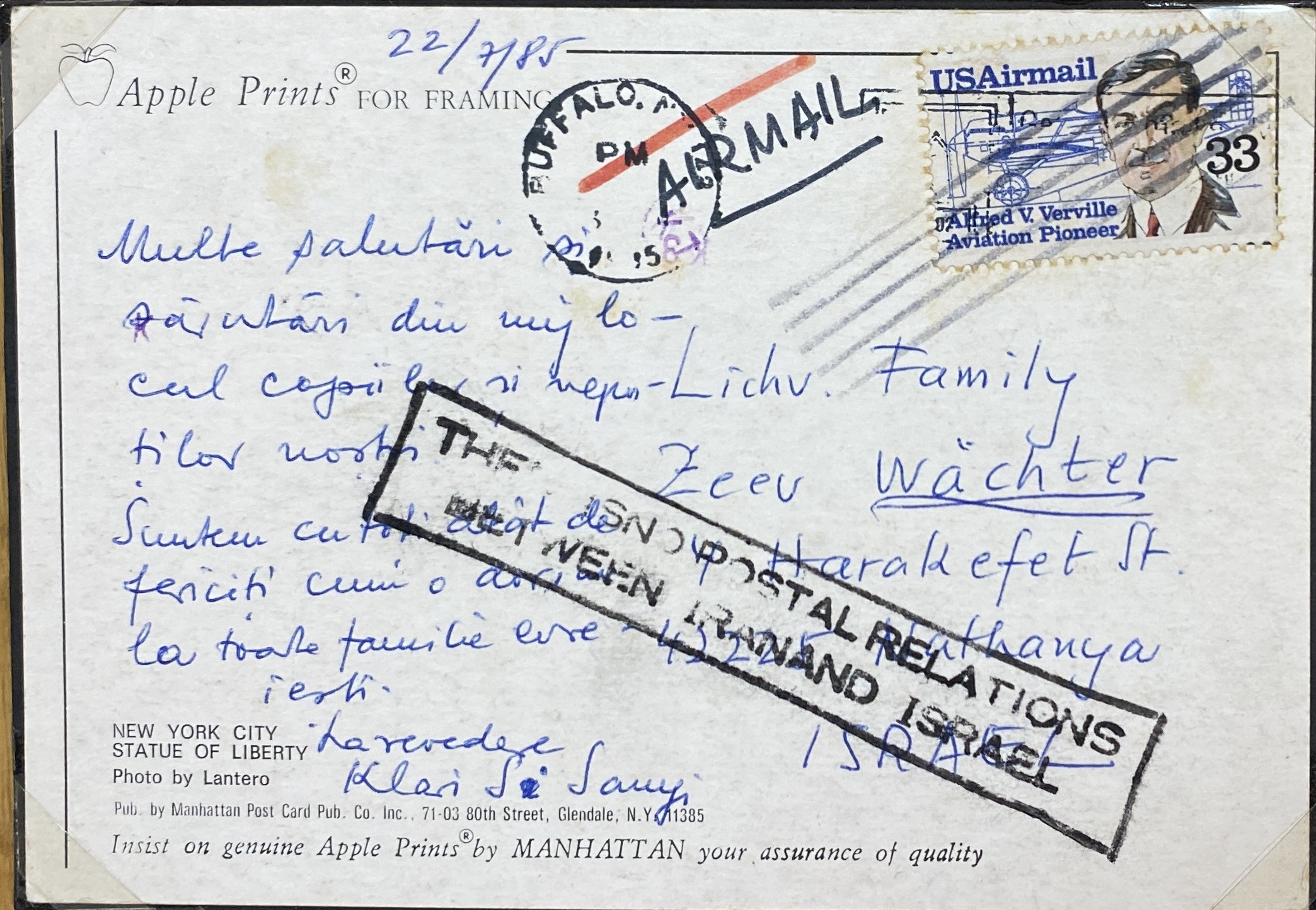
Postcard sent from USA to Israel that was routed in error to Iran. 


In the 1980s, I had a huge interest in mail from Arab countries with no relations with Israel. Items such as the one above were the most difficult to find seeing as how these were pre-Internet days. However I saw an auction lot showing letters from Iran, addressed to Geneva, and it had Hebrew writing on it. This really piqued my interest and I purchased the lot. In those days I worked in a company where there was an Iranian ex-pat and I showed her the lot. She looked at it and said the postbox number looked familiar, so I decided to do some digging.

As I said, there were no postal relations between Iran and Israel, meaning that Jews in Iran couldn't send letters to relatives in Israel. The Israel Broadcasting Authority attempted to fill this void. The I.B.A. set up a post office box in Switzerland (P.O. Box 152, Geneva) which was meant to receive mail sent from Iran. Every day, the I.B.A. broadcast the news in Farsi to listeners in Israel and out of Israel. This transmission was broadcast as far away as Iran. The gist of the broadcast was that listeners could write to "Radio Israel in Farsi" at the given address.

Mail leaving Iran, generally to non-Moslem countries, was often censored by the Iranian authorities and as a result people sending to this drop box did not put a return address on the envelope. Very often people did not even put stamps on the envelope so that they would risk entering a post office. This mail was then taxed by the Swiss Postal Authorities.

Since this service was quite open, there was always the possibility of terrorists using it to send letter bombs. As a result, when suspect mail arrived in Israel's hands, it was screened for letter bombs and "Checked" hand stamps were applied. The security officer who checked the mail signed the hand stamp as proof of its authenticity.


In theory, this could be used by Jews in all countries having no postal relations with Israel, although there were very few as many had been expelled from their host countries.

It is impossible to know how many letters were sent via this method as the Jewish community in Iran is not large and no records are available but it helped Jews in Iran who had no other way of getting word to Israel.

  • "Undercover mail with Iran" ~ Lawrence Fisher, HLPH 57 -58


Print Friendly and PDF

Sunday, May 23, 2021

Sending mail to forbidden countries

So I am browsing the net, looking for a certain item and I find it. I go through the purchase process and get to shipping and find, what? That Israel is one of the few countries that they don’t ship to. Why is that? Could it be for ideological reasons or could it be that Israeli post has a bad reputation? Doesn’t make a difference, they don’t ship to Israel, yet it is an item I want, be it a cover or an item of clothing. So?

Well today there are services in place, via a third party. You pay for a service which provides you a post box number in, say America, and have them ship there. That same service then collects your parcel from that postbox and forwards it to you for an exorbitant fee and you are happy.

What has that good to do with philately? Good question, thank you for asking. In 1967 Israel took over control of what is known as the West Bank and Gaza and I am intentionally leaving politics out of it here. However, all of a sudden, we have a few millions new inhabitants who are closed off from their family. They can’t use email as it hasn’t been invented yet and they can’t send letters as no postal relations exist between Israel and many of those countries, many who are still in a state of war with Israel.

So what can they do? The answer my friend is not blowing in the wind, it is in the first paragraph. A third part!

The first obvious system was the Red Cross. With the Red Cross you could send a message to anyone via the Red Cross, however these were brief messages and anyone can read them. If you don’t like what is written there, somehow it will not be delivered.

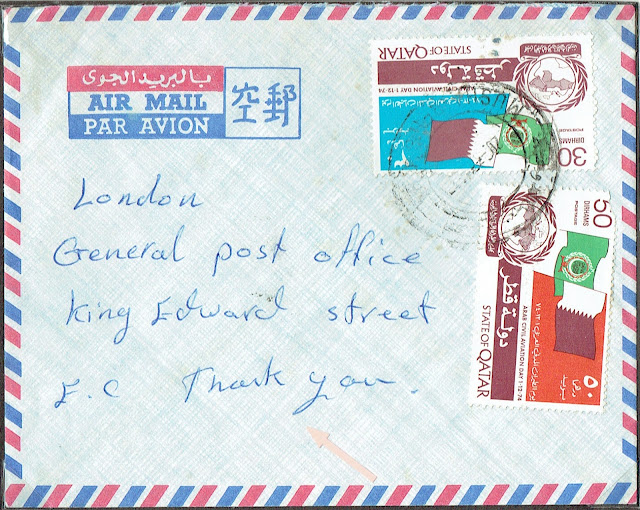
Along comes a bright spark and says, let us send mail via the London Post Master and they did. How did it work? A letter was sent from Israel to the Post Master of King Edwards Street in London. Enclosed in that letter was another letter intended for a third country, say Iraq, and an International Reply Coupon. This coupon was intended for use by the London Post Master to pay for the service. One advantage was that the chances of the mail being read was minimal and you could write whatever you want and how much you want. Actually there was a second address in London and an address in Cyprus.

Ingenious, right? Well it was modelled after the famous World War 2 Thomas Cook service in which someone from Nazi occupied areas could send mail to family or friends living in Great Britain or Palestine, for that matter, to an undercover address of POB 506, Lisbon, Portugal. The Thomas Cook office in Lisbon would then forward the mail to Great Britain or other countries.


From Qatar to London and thanking them for the service

 
In the hopes for peace, Defense Minister Moshe Dayan decided upon an Open Bridges policy, so that people could cross from Jordan to Israel, hopefully for trade or to visit or whatever. Now we have an open bridge and people crossing and what did they do? Well some people took letters for others. They folded them in their pockets and in essence were supposed to go to the Allenby Bridge Post Office, buy stamps and post them, but many didn’t. They were scared of being caught and just shoved the letters in the post box without stamps. Of course the recipient was then forced to pay the postage cost, but also the fine. This method was better than the London idea because it was much quicker.

So we now have a border crossing and people who want to visit, but what is missing? Tourism! After all some of the holiest Christian sites are in what is known as the West Bank. So some tourist companies jumped on the band wagon and purchased Israeli stamps. “If you don’t know anyone crossing the border, send it to us, we will send it”. They obviously charged a nice fee because why do it for nothing. You can see that the fee was paid either by the application of a label or the company’s special cancel.

Label of the Amman Halabi Touring Company. Folded as they probably didn't have stamps yet
  
This practice is sometimes known as undercover mail.

Some of these are in use today. There are people in cities such as Jaffa who buy items locally and send them to countries with no relations or that they don’t want to actively buy from us.

I have outlined some of the methods that our Arab brothers communicate with others, maybe next time I will write about methods that Jews in Arab countries, those that are still left, communicate with Israel.

For more information see "Mail Contacts Between Israel and Arab Countries - a Summary" by Lawrence Fisher, H.L.P.H. Journal VI #109-110, pages 333-353, 2008. 


Print Friendly and PDF

Tuesday, November 10, 2020

Spying on us

Here is a nice story for the day.

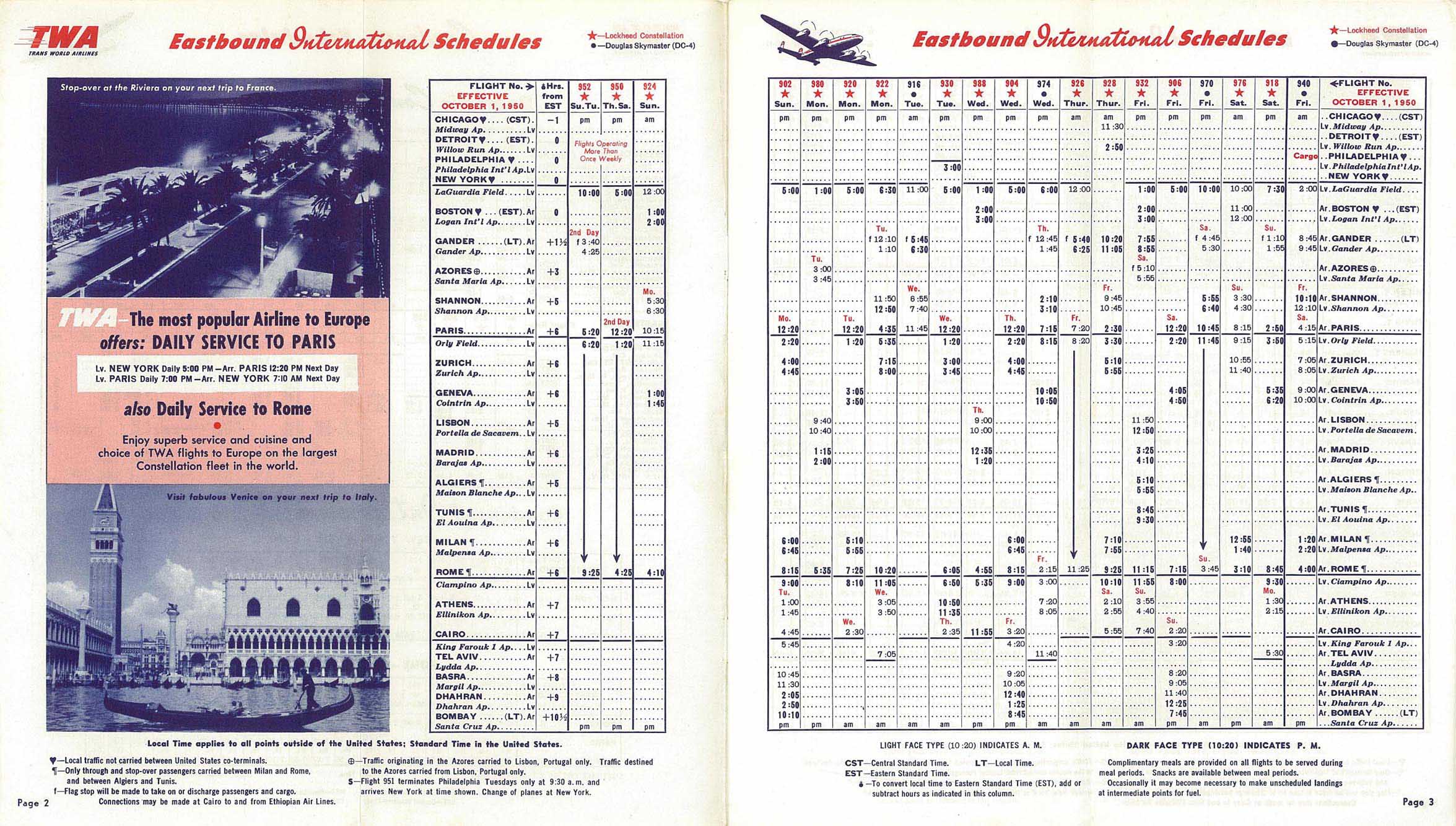
As we all know 15th May 1948, neighboring Arab countries invaded Israel from all sides, in what became known as the War of Independence. The day before, Israel declared independence from Britain as the Mandate ended. Knowing that there was going to be a war, many airlines stopped flights to Israel. TWA stopped flights as of 19th March 1948. TWA renewed flights to Israel, after the war, on the 5th July 1949.

So a year later, a TWA flight left America for Israel in September 1950. In October 1950, and probably before that, the route was Rome - Athens - Tel Aviv, as can be seen from the image below.

The flight arrived in Rome, Italy and then departed on 18th September with 14 passengers and was scheduled to arrive at LYDDA airport, near Tel Aviv, that same day. Unfortunately due to engine trouble, the plane was forced to land in CAIRO.

Remember that September 1950 was barely a year and half after the ceasefire of the War of Independence and Israel and Egypt were not exactly on speaking terms. Egypt could not really come to terms with the fact that they were unable to wipe the Jewish state off the map. If they had, I wouldn't be writing this blog.

One could ask why would the flight land in Cairo, that seems very off route, if there was an Athens leg. One source said that the flight was forced to land in Egyptian occupied Gaza, which is highly unlikely as in 1950, as today, there is no landing strip there.

In Cairo, the mail bags were taken off the plane by the Egyptian Military. On board was mail originating from New York, Boston, Buenos Aires, Rio de Janeiro, Madrid and Rome. The Egyptian authorities refused to release the mail. Actually as of the 20th they hadn't even released the plane itself. Israeli authorities approached the International Postal Union and protested at the confiscation of Israel-bound mail.

There were about 19 mail bags on this flight. One source said that the mail was only released as a result of American threats. Mail was only returned to the sender after being heavily censored trying to get information. Mail began to arrive in Israel in February 1951, some six months later.

What is also puzzling here is that there were 14 passengers aboard, what happened to them while in Cairo? A question that I don't have an answer for. Anyone?


Print Friendly and PDF

Statcounter