Showing posts with label Boycott. Show all posts

Monday, October 24, 2022

Undercover mail from Iran

Israel always had good relations with Iran during the regime of the Shah. Iran was one of the few Middle Eastern countries that had any relations with Israel. Mail passed freely between the two countries. When the Ayatollah Khomeini took power in 1979, mail from and to Israel was no longer handled. Mail to Iran was stopped in 1983. Mail from Iran addressed to Israel was returned to sender and received an instructional marking of "There is no postal relations between Iran and Israel". Israel was suddenly cut off from Iran. Note: The actual message was: "Thereis no postal relations between Iranand Israel".
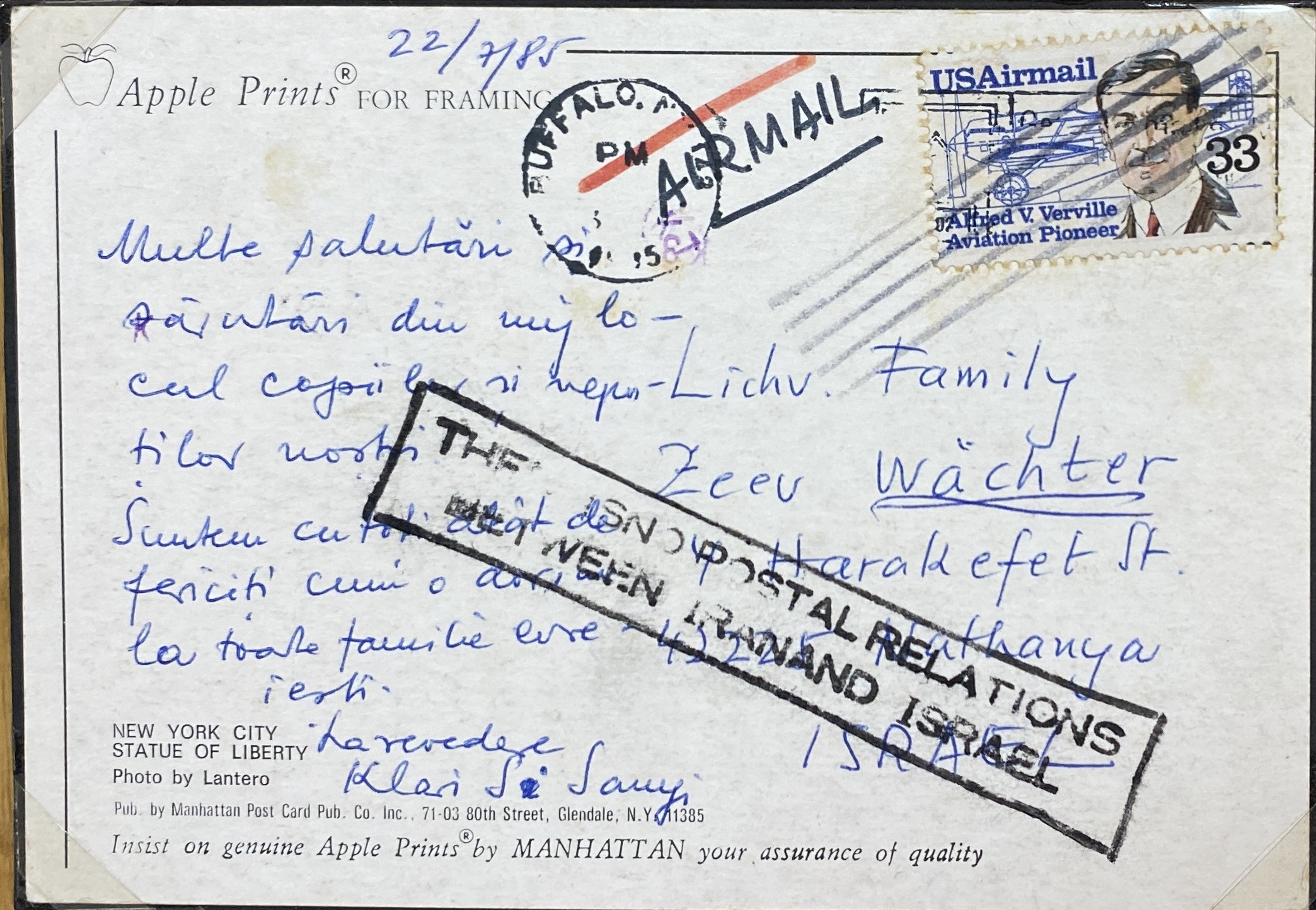
Postcard sent from USA to Israel that was routed in error to Iran. 


In the 1980s, I had a huge interest in mail from Arab countries with no relations with Israel. Items such as the one above were the most difficult to find seeing as how these were pre-Internet days. However I saw an auction lot showing letters from Iran, addressed to Geneva, and it had Hebrew writing on it. This really piqued my interest and I purchased the lot. In those days I worked in a company where there was an Iranian ex-pat and I showed her the lot. She looked at it and said the postbox number looked familiar, so I decided to do some digging.

As I said, there were no postal relations between Iran and Israel, meaning that Jews in Iran couldn't send letters to relatives in Israel. The Israel Broadcasting Authority attempted to fill this void. The I.B.A. set up a post office box in Switzerland (P.O. Box 152, Geneva) which was meant to receive mail sent from Iran. Every day, the I.B.A. broadcast the news in Farsi to listeners in Israel and out of Israel. This transmission was broadcast as far away as Iran. The gist of the broadcast was that listeners could write to "Radio Israel in Farsi" at the given address.

Mail leaving Iran, generally to non-Moslem countries, was often censored by the Iranian authorities and as a result people sending to this drop box did not put a return address on the envelope. Very often people did not even put stamps on the envelope so that they would risk entering a post office. This mail was then taxed by the Swiss Postal Authorities.

Since this service was quite open, there was always the possibility of terrorists using it to send letter bombs. As a result, when suspect mail arrived in Israel's hands, it was screened for letter bombs and "Checked" hand stamps were applied. The security officer who checked the mail signed the hand stamp as proof of its authenticity.


In theory, this could be used by Jews in all countries having no postal relations with Israel, although there were very few as many had been expelled from their host countries.

It is impossible to know how many letters were sent via this method as the Jewish community in Iran is not large and no records are available but it helped Jews in Iran who had no other way of getting word to Israel.


  • "Undercover mail with Iran" ~ Lawrence Fisher, HLPH 57 -58


Print Friendly and PDF

Monday, February 28, 2022

What is Aryanization?

It is no secret today that Hitler didn't like the Jews, in fact he hated them and wanted them out of Europe. In Germany, a hundred years ago, Jews were a part of everyday life, doctors, scientists, bankers, lawyers and many others and some were very wealthy. The Nazis preferred Germany for the Germans, Aryans, and in their eyes Jews were foreigners. They were not blue eyed, blond adonis.

When the Nazi party took over Germany in 1933, they immediately set about removing Jews from all walks of public life. Jews were sadly removed from many jobs in the public sector such as the civil service and teaching or forced to work only as consultants as can be seen here: . However there were many Jewish owned businesses, some successful and much like today, a boycott on Jewish business was enforced. There were even calls for Jews to "Go back to Palestine". Ironic as today many Europeans are saying get out of Palestine.

A simple boycott of Jewish businesses was unacceptable, because some of the businesses such as the Herman Teitz department store, were very successful. Hermann Tietz, the co founder of the Herman Teitz department store, was born in Poland and he was the first to carry out the idea of the department store in Germany. The Berlin Ka-De-We store was one of their stores. Try and boycott the network and you cut off your nose to spite your face. So what do you do?

The Nazis came up with Arisierung or Aryanization, or the transfer of Jewish owned property to non-Jews, meaning make those businesses Aryan. There were two distinct phases, Voluntary which was from 1933 to Kristallnacht (1938) and Forced which was after Kristallnacht.

Under "Voluntary Aryanization" the Nazis forcefully encouraged Jewish businessmen to sell their businesses at a fraction of their value, often as low as 20 to 30%. As it was they were facing economic and social discrimination. One of the companies that was voluntarily forced to sell out under these terms, was the Herman Teitz Department store. But Houston we now have a problem. This was a well know company and their logo was well known. You cannot have a Jewish sounding name. So the Nazis changed the name to Hertie (Herman Tietz). Check out the image.


Under this "voluntary" situation, about two thirds of Jewish owned businesses either closed their doors or sold out.


Along comes the 1938 violent Kristallnacht pogroms (November 9-10) which showed Jews that they were no longer at home in Germany, as if by now they had any doubt. But in the aftermath of the events, on 12th November, the German government issued "The Decree on the Elimination of Jews from German Economic Life". This law effectively barred Jews from operating stores, agencies and trade. They were forbidden to sell goods or services of any kind. The "Decree on Utilization of Jewish Assets" of Dec 3rd set a time limit for the transfer and set a value of the sale of the firms, at a fraction of their market worth. Every remaining Jewish business was given a non-Jewish person to oversee the immediate sale to non-Jews. Their fee was almost the same as the amount of the sale and was paid by the former owner. This meant that the Jewish owner came out with next to nothing. As an example the "Jos. Koenigberger Tuchfabrik Company", was forced to sell to "Tuchfabrik Meissner & Co. K.G."


I would like to say that since the horrors of the Holocaust, just under a hundred years ago, that we have evolved, but with the anti Jewish laws in some countries (Jews cannot own property or else the sale of land to Jews is a death sentence) and the rise of hatred worldwide, I unfortunately cannot.

Print Friendly and PDF

Tuesday, October 20, 2020

Postkrieg or Postal War

In his book "On War", Carl von Clausewitz stated that "War is a continuation of politics by other means". Many of us have not heard the term Postkrieg or postal war. It is defined as a Postal War. Postal War is defined as measures taken, obviously for political reasons, by one country against another. It attacks postage stamps issued by a postal authority, postmarks, slogans or any postal material. 

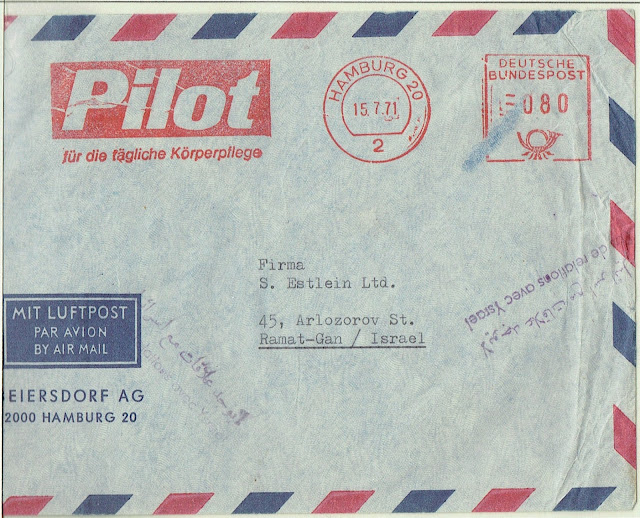
When dealing with our area, the Arab countries had no postal relations with us and letters sent to Israel, but landing up in Arab countries, were returned to sender after application of a cachet. But that is a simple case of a boycott against us or a lack of postal relations. However this is a continuation of the war and fits Clausewitz's theory.


As an example of our postal war, the year 1960 was declared by the UN as "World Refugee Year ". Many countries issued stamps to publicize the year. Israel issued two stamps, one depicting Jewish Yemenite refugees arriving to Israel on a flying carpet. The second depicting a Jewish Yemenite refugee family building their new home in the land of Israel. Romanian postal authorities took offense and with the case of Israel, mail using these stamps was returned. Covers bearing "World Refugee Year" stamps from Israel and others received a rubber stamp with the following text: "RETOUR AFFRANCHIE AVEC TIMBRES NON ADMIS" (Return/Franked with/Inadmissible stamps).


After the Six Day War, Eastern European countries, mainly Poland, Romania, East Germany and Russia, had an outright postal war with Israel, returning mail when they did not like the stamp used or the slogan. Often a cachet or label was added such as “Not Admitted in Accordance with the UPU Convention for Glorification of Military Aggression on Postage Stamps”, in essence accusing Israel of the aggression against Arab States.

In the item below we can see that the problematic stamp is the one depicting the Straits of Tiran, at the entrance to the Gulf of Sinai. 


The Eastern European countries often point to Article 28 section 1d for validation. The Universal Postal Union (UPU) cannot declare a stamp issued by a member's postal administration as invalid. However according to the UPU Convention, the issue of postage stamps should contribute to better understanding between nations, their different cultures and international friendship (UPU Resolution, Ottawa 1957). Article 28 enables members to refuse to deliver mail if certain conditions are met. Article 28 (1d)enables members to refuse to deliver mail which contain “objects of which the import and circulation in the country of destination is forbidden”. Stamps / slogans fall under this category?

A postal war existed between East and West Germany from as early as 1949 and items have been seen as late as the 1970s. This war provided us with a lot of interesting philatelic items, such as stamps totally, blackened out or removed or simply refused to deliver and returned to sender. In some cases the blackening out of the stamp was so severe that you could not see the stamp itself or tell which country it was sent from. Only the return address gives the clue as to where the letter originated from. 


East Germany declared Berlin as its capital and this was not recognized by France, US or England. In 1961, East Germany started a campaign declaring East Germany as their capital and introduced a cancel with the slogan, “Berlin – Capital of DDR”. The special cancel had about seven different designs during the 1960s. This started a new phase of the postal war as mail with this cancel that entered West Germany received a red cancel with the slogan “Berlin is the Capital of Germany, not the Soviet Zone”. It is believed that three different versions of this counter cancel exists.


The Palestinians are demanding a part of Jerusalem as their capital, a new postkrieg in the future?

Note: Previously published in the Israel Journal of Thematic Collecting

For more information on Postkrieg, please check out: http://www.postalwar.info. There is also a catalog for sale (I have a copy, so I can recommend it). https://www.postalwar.info/content/books.php


Print Friendly and PDF

Statcounter