Tuesday, March 16, 2021

Operation Cornflakes

Let’s start with today’s story, a story I like to tell many times but I haven’t written about it. I was reminded of this story as a result of the exhibt of a colleague of mine, that of Menachem Lador talking about secret services, another fascinating topic. And here's a link to his display. During a war, there is often an attempt to undermine the morale of the citizens so that they put pressure on their government to end a war. The term is called demoralization. This is usually the case in a war of attrition.

Demoralization is not a new phenomenon and during World War II, both the Allies and the Axis Powers used tactics to try and undermine the morale of citizens. One covert operation created by the Office of Strategic Services (OSS), the American spy agency during World War II that later became the CIA, became known as "Operation Cornflakes." Sounds delicious, doesn't it? A Kellogg's campaign during which you get a knock on the door in the morning and someone hands you a bowl of cornflakes? Well, it's not.

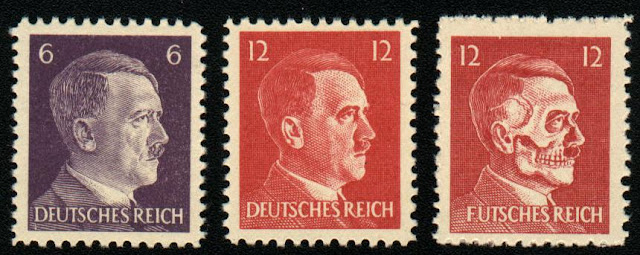
One of the stamps, issued by the Germans was the Hitler head series. So what did the OSS do? They took the stamps (specific values and you will soon understand why) and forged them! Instead of the usual Hitler head, the fakes showed Hitler's head as a skull or "death head." One of the stamps printed the name of the country as "Futsches Reich" which means "ruined empire" instead of "Deutches Reich".

With permission from SGM Herbert A. Friedman

Just as matter of interest, it is documented that Hitler was paid to be able to use his portrait on postage stamps. It was paid for by something called a Cultural Fund. This is also where he was paid the money from hi book, "Mein Kampf"

Our OSS friends led by General "Wild Bill" Donovan, had to learn everything about the German postal service. So what did they do? German Prisoners of War who were former postal workers, were interrogated on every slither of information, from the postage stamps to methods of packing and sealing mailbags. For this work, they received benefits like tastier meals and so on. Anti-Nazi spies and residents, collected samples of cancellers, postage stamps, mailbags and envelopes. They even took German phone books with addresses of the residents. Today with our smartphones, who remembers the piles of phone books next to our telephone that was connected to a wall!

Now they have addresses, fake stamps, mailbags, knowledge of methods, so what's the next step? Writing the letters themselves. The letters were written, full of anti-Nazi propaganda, to as many citizens as possible, using the forged stamp and fake postmark. In each letter they placed the Hitler skull parody stamp. But they then encountered a problem. Without asking anyone, and without informing the OSS, the Germans changed the laws and only allowed mail from legitimate businesses. No problem, the sender's address will carry the addresses of legitimate businesses that they of course took from the phone number. In the interim they duplicated the mail bags and every other detail of the German postal service. What an operation.

The question now is how to insert these letters into the German postal service? After much thought they came to the conclusion that the best way is to bomb mail trains from the air. Once the bombers managed to stop the train, they had to drop the false mailbags into the rubble. Thus, the Germans would find the mailbags and assume that they belonged to the damaged train and transferred them for further treatment and thus reach their destination. This type of propaganda is called black propaganda. Black propaganda is a type of propaganda designed to create the impression that it was created by someone who is supposed to discredit it.

A beautiful story, no? So speaking of letters, why was it called Operation Cornflakes?

In those days, in the United States, cornflakes was a very popular breakfast food and in Germany the mail was delivered at breakfast, so the Allies felt that if German citizens received their demoralization propaganda at breakfast, they would feel that the German Reich was indeed "falling apart." A covert operation named after food!

On February 5, 1945, a German train traveled to the city of Linz. The Mail Car held mail delivered to several towns in northern Austria. Suddenly, Allied planes attacked, dropped bombs, and dropped the mailbags. Eight mailbags hit the ground around the train with a thump. Inside each bag were about 800 propaganda letters, all directed to homes and businesses along the train route and properly addressed. When the train was discovered, German postal workers exchanged bags and forwarded the letters without knowing anything about their contents or origins. The operation had begun.

During the operation, 20 missins of counterfeit mail, with about 320 mailbags and over 96,000 propaganda letters were dropped. Although there was a considerable amount of mail, I have not seen many for sale. A friend sent me a photograph as an example, and it is depicted below.


What is interesting about the story is that the items are relatively difficult to obtain, and therefore there are forgeries on the parody, so you need a certificate to show that it is genuine. Can you imagine a forgery of the forgery? Before you start looking for letters like, remember one thing, the stamps on the letters were not the ones with the skull because people would immediately recognize that it was not real, but most of the time they were inside the letter with the propaganda page. Remember, this is black propaganda!

No one knows how successful the operation was but at least it gave us something to enjoy. The story is based on an article by another colleague of mine. And here's a link.

If you like this post, please leave a comment, even better if you share it.

 
Print Friendly and PDF

Tuesday, March 9, 2021

Whiskey Mail

Our story, this time, is particularly interesting, as are all of them in my own humble opinion, and I am telling it because of a previous story and you will soon understand why. Remember there was a war of survival in Israel in 1948? So the city of Safed, which is located somewhere in the north of the country, is not exactly a new city and the fortress in the city was actually built by the Crusaders. For religious Jews, it is one of the four most important cities in the Holy Land and people who study Kabbalah, the Jewish mysticism, like the singer Madonna or Esther for you, tend to visit it, both publicly and secretly, well it is hard to do anything secretly in the modern world i.e. Facebook.

When the UN announced their Partition Plan in 1947, everyone knew there would be a war for our survival in the country and we knew it because the Arab countries said so, several times. Too bad we did not know about Daniel Webster then. Actually the war or at least the skirmishes, started in early 1948 and there were many. It was the war of the roads.

And this brings us back to the events of Safed. In 1929, in one of the riots of Arab residents, about 20 Jewish residents were murdered and since in 1948, there were 6 times more Arabs than Jews in the city, and quite a few of the Jews were old men, the Jewish residents knew they were in trouble. So what could they do? Pack up and leave? No! Stay and everything will be fine, or not. Most of them stayed and it began, and hard. Already in early January, Arabs attacked the Jewish Quarter, and in February, they attacked a Jewish bus on its way to Safed and many other incidents.

In early February, Arab forces killed a Jew at the entrance to the post office in Safed, and the British immediately closed the post office on the grounds that it was too dangerous for them and everyone else. The British army controlled Safed but did not raise a hand to stop the attacks on Jews. This meant that there were no postal services for the residents, at least not for the Jewish residents. There was some contact with the neighboring city of Rosh Pina, that Palmach soldiers came by foot through Mount Canaan to fetch mail, after all there was no WhatsApp at the time and they still had to get messages. Of course the amount of mail was limited.

In March, Jewish traffic on the Rosh Pina road - Safed Road, was attacked and as a result the road to the east was closed. From the west the road passed through two hostile Arab villages and Jews could not travel on it. So the Jewish community was under siege, difficult to enter and difficult to leave. They were dependent on the good will of the British soldiers and anyone who knows history, then and today, knows that they were never very fond of us.

Suddenly on April 15 The British announce that they were leaving. They offered to evacuate Jewish elders and women and children with them, but no one wanted to, after this was their home for centuries. "We are staying put!" The British thought the Jews would last maybe two hours after they left.

Is this the end? of course not. Palmach forces arrived to replace the British but the amount of Jewish soldiers was far less than the Arab forces and of course they had much less weapons. The Arab forces approached the Jewish Quarter and the residents felt they were in trouble. The Jewish Quarter being under siege, lacked basic products such as flour and water and more. What do we do?

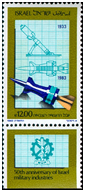
As we mentioned in one of the previous newsletters, no one wanted to sell us weapons, so either we bought, steal or make our own. One of our inventions was a mortar called the "Davidka" or "Little David", so named after its inventor, David Leibowitz. Her missiles were noisy, very noisy, and very inaccurate and therefore of little value. But what to do, there are no other weapons so started using Davidka and bombing the Arab quarter in the city. The terrible noise so frightened the Arabs that they just ran away. They abandoned the city, and Safed fell to us.

Mahmoud Abbas, who was born in Safed in 1935, says that they fled in 1948 because they thought the Jews would slaughter them. Probably ran away because of the Davidka.

Well I told you a bit of the history and you may be asking yourself or not, what has this going to do with philately apart from the Davidka stamp? So, I told you that from February there was been no post office in Safed, after the British closed it, and I told you that Palmach soldiers managed to deliver some letters. But in Safed there were merchants and banks, and there was one bank, Klinger Bank, which had a local branch. That branch was attacked in the Arab riots of 1929 and twenty years later chaos returned!

The postal service was important to conserving the day to day business of the bank. How can they continue to function and communicate with the outside world, even with Rosh Pina, without orderly postal services? But what could they do, there was none, the British stopped it lock, stock and barrel.

Mr. Klinger took advantage of his good relationship with some of the higher ranks of the British military who controlled Safed and got their permission for British soldiers, who travelled freely on the road between Rosh Pina and Safed, would bring mail bags in their trucks. Knowing that they were returning home in a few months, an order from above did not mean that they would carry it out. Why take unnecessary risks? Mr. Klinger found a nice way to motivate the soldiers. I hope my managers are reading the blog right now, he promised a bottle of whiskey to every soldier that completes his task, meaning delivers the mail bag. A bottle of whiskey per bag mail that they delivered and this time the purpose of the whiskey was for drinking and not for washing hands or disinfection. Message to my boss, Blue Label is appeals to me, hint, hint...

All letters that arrived in Safed during the British Mandate between March 1 and 16 April, are known as "Whiskey Covers".

The story is taken from the book of Postal History of the Transition Period of Israel, 1948 Part I.


I don't have one in my collection. The item depicted here was in an auction of Tel Aviv Stamps.


Print Friendly and PDF

Tuesday, February 16, 2021

Disinfected mail

I must say I do not like Corona. Why did they name a beer after a virus? The truth is, I personally do not like beer, much prefer wine or whiskey, and that fits into today's story.

I got to see a few short videos recently, one of which was by Monty Python, they are always valid in my opinion. The new president of the United States has declared that the United States has crossed the threshold of half a million deaths from the virus, more than all four years of World War II (remember that the United States entered two years after the war began). At the same time in the Monty Python video I was watching, I heard someone call out, "Bring out your dead, bring out your dead" and then I decided to take out this newsletter.


 About 700 years ago, Europeans did business with the Far East, and they had heard about some deadly disease that was spreading somewhere in the East. The World Health Organization did not address the issue properly, much like a year ago, but in this case, they did not exist.

This disease dubbed "Black Death", and probably reached European shores by traders from regions
that were badly infected. The innocent Europeans did not know how to deal with the epidemic. I will not go into the symptoms of the disease, our Corona is bad enough and probably when comparing it to the Black Plague, Corona may be mild, but the disease was passed from person to person, also by touching. Remember that in the beginning of Corona people walked around with gloves? And people came out with patents how not to press elevator buttons? Only then did they not have alcohol to wash their hands, they had alcohol for the reason it was invented - For drinking. During the past year I have had more alcohol on my hands than in my stomach, for better or worse.

It turned out that the disease was passed from person to person mainly through fleas and rats, that ran amok not only on the ships but also in houses, remembering that at that time, people did not shower every day and not every house had running water.

Who was blamed for the Black Death? Not the rats but the Jews, of course. OK, some people even today thing that it is the same thing. Why were the Jews blamed this time? First of all because of our customs. We wash our hands before a meal and therefore less people fell ill. Even today, in these Corona times, washing hands is one of the main guidelines. Also in our New Year festivities, in Tashlich, it is customary to throw your sins into running water. So people claimed that we were polluting the water sources. Because of these accusations, thousands of Jews were murdered.

Eventually the Republic of Venice declared that anyone entering the Republic, sailors, tourists, merchants, etc., was obliged to be forced into isolation for forty days. They called it quaranta giorni and from there we get the word quarantine. Those who fell ill and died during the isolation period did not endanger the residents of the city. Anyone who was suspected of being ill or was visibly ill, could not enter, nor receive medical treatment. No one knew what to do anyway.

But where did the number 40 come from? According to Douglas Adams, 42 is the meaning of life but 40? The number forty is considered to have almost special magic properties, and is mentioned in the Bible about 130 many times: the flood lasted forty days, 40 years of wandering in the desert and more and it also appears in Christianity: Jesus ascended to heaven forty days after his resurrection and there are more examples. Islam also adopted the number and the period of mourning in Islam lasts forty days.

Here in Israel, during the first Gulf War, between Iraq and the world, we sat in sealed rooms with gas masks for fear of a biological attack. Well in those days of epidemics in Europe, Mongol forces laid siege to the city of Kappa, situated in Crimea. During the siege, the Mongol forces suffered a plague, and with the help of catapults, hurled the diseased bodies into the besieged city. In doing so, the Mongols invented the biological war.

At the beginning of our plague, people were afraid to receive packages from China for fear that they would contain Corona remnants. Eventually the postal authority issued a circular saying there was really no problem. But in previous years, people believed that diseases, such as Cholera and Yellow Fever, could be spread through the mail, so methods had to be found to disinfect the mail, seeing as how mail was the only means of communication. Because of this, the postal authorities and the state tried to disinfect the letters that arrived.

Today you would not receive a letter in which holes are made, cuts or stains are covered, but in the days of epidemics in the world it was completely normal. One of the most common methods was smoking in the oven or using vinegar. Incisions were made and holes were punctured in advance so that the contents remained intact but the viruses and bacteria were killed and that apparently did the trick.

The letter shown here was sent from Aleppo in Syria to Livorno in Italy in 1692, probably through Beirut and was treated with scorching. Aleppo had a large Jewish community and Livorno also had a large community of Spanish Jews who were expelled in 1492. According to the names, it is possible that the letter was sent from Jew to Jew.


The information comes from several sources as well as from Dr. Hedy Faivel in his article "The Evolution of Infectious Diseases" in the Israeli Thematic journal, Noson, Journal 115.
 

Print Friendly and PDF

Tuesday, February 2, 2021

Spotlight - a surprising cover from UNRWAPR

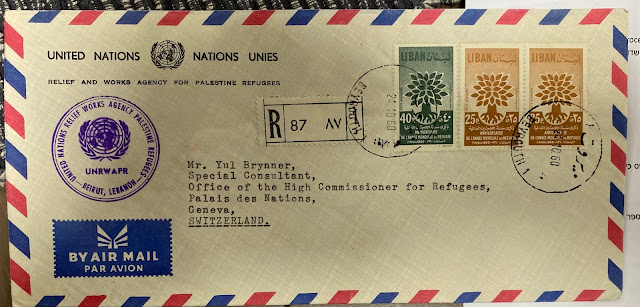
I recently began to build a one-frame exhibit on the Palestinian refugee problem. While searching for material for this exhibit I came across a sale of the cover shown below. On the front is a private cancel (not a postmark) in purple for "The United Nations Relief and Works Agency for Palestine Refugees". The initials of this organization are UNRWAPR, but most of us are mostly familiar with the abbreviated acronym UNRWA. However this was the initial name.

When the letter arrived I first noticed the name of the recipient, and I realized that there is an interesting story here. The letter was sent in October 1960 from the UNRWA agency in Beirut by registered mail, and it carries the International Refugee Year Stamps. The letter was sent to Mr. Yul Brynner, Special Adviser to the UN High Commissioner for Refugees in Geneva.


The High Commissioner for Refugee Affairs is an office established in 1950 in order to assist refugees all over the world to integrate in the countries in which they reside. This commission, which has its hands full of work to this day, has also twice won the Nobel Peace Prize, in 1954 and 1981. Because Arab states opposed the integration of Palestinian refugees into their states, it was decided on the establishment of a separate body - UNRWA - that dealt exclusively with Palestinian refugees.

I guess we all remember film and theater actor Yul Brinner, mostly because of his unforgettable performance as King Mongkut of Siam in the musical "The King and I" on Broadway stages and on the movie screen, for which he even won the 1956 Academy Award. Brynner died in 1985, at the age of only 65, from lung cancer because he was a heavy smoker. In the last months of his life he joined a campaign by the American War Association that called on the public to quit smoking.

A brief examination I conducted revealed that in 1959 Brynner was appointed special adviser to the High Commissioner Of the United Nations Office for Refugees. 1960 was declared International Refugee Year, and Brynner used his status as an international superstar and was interviewed by media all over the world to highlight the plight of millions of refugees.

It turns out that Brinner was also an amateur philatelist.

An American friend showed me two more Yul Brynner covers related to the United Nations. One is shown here as it is also related to refugees. These covers seem to be philatelic in nature, and it is doubtful that they were actually sent. It is clear that Brynner collected such items, presumably to keep a souvenir for himself from his time as a "special adviser."


This was originally published in a Hebrew language two monthly newsletter, NosonNet, and was translated from that newsletter

Tuesday, January 26, 2021

Caroline Affair

Let us begin with a joke.

A CNN reporter, a BBC reporter and an Israeli commando are captured by ISIS in Syria. The terrorist leader told them he would grant them any last request before they were beheaded. The CNN reporter said, "Well, I'm American, so I would like one last burger with fries." The leader instructed an aide to bring a burger and fries. The reporter ate it and said "Now, I can die."
The BBC correspondent said, "I want to take out my tape and describe the scene here and what's going to happen. Maybe one day someone will hear it and know I was on duty until the end."
The ISIS leader ordered the aide to hand over a tape and dictated some remarks. The reporter then said, "Now I can die knowing I stayed true to the end."
The ISIS leader then turned to the Israeli commando and said: "And now, Mr. tough Israeli guy, what is your last wish?"
"Kick me in the ass," the soldier said.
"What?" The leader asked, "Are you joking with us in your final hour?"
"No, I'm not kidding. I want you to kick me in the ass," the Israeli insisted.
So the terrorist leader pushed him into an open area and kicked him in his ass. The soldier fell over, but rolled to his knees, pulled out a 9mm pistol from under his shirt and shot the leader dead. He jumped into his bag, pulled out an Uzi machine gun and shot the rest of the terrorists.
"Why didn't you just shoot them at the beginning? Why did you ask them to kick your ass first? "
"What?" The Israeli replied, "And that you will report that I started and I am the aggressor?"

And why am I telling you this? Good thing you asked because it is a result of things I hear on social media. So let’s embark on our story of the day. 

Is it true that the United States and Britain are allies? Yes, it is, but that was not always the case. England once controlled a part of America but after gaining independence England, the conflict did not end. Is that a hint to us, here in the Middle East?

War broke out again in 1812 and this is actually the beginning of the story. Wait with me until the end because it connects to the joke I told you. So after the war there were negotiations and the parties resolved the disputes between them. However, there were those in the United States who still claimed that part of Canada belonged to the United States and in Canada there were those who dreamed of independence from Britain.

In 1837 a failed revolt took place against British rule. Part of the revolt was in Quebec, which is French-speaking. In Ontario, on the other hand, many of the leaders of the uprising were American immigrants to Canada. Their leader was a Scottish Baron named William Mackenzie. The revolt was quickly defeated. Mackenzie fled to Buffalo, where he persuaded a number of Americans to join his cause. Mackenzie and other Canadian rebels, backed by American citizens, fled to an island in the Niagara River, in an American steamboat called the Caroline.

Canadian militia, on orders from the British, crossed the Niagara River and captured the steamboat while it was docked in American waters. The militia set fire to the Caroline and threw the ship over Niagara Falls.

These actions strained US-England relations almost to the brink of war. The American side saw the raid as a blatant and unshakable attack on a neutral state. The British and Canadian sides justified the need to deal with security threats that the United States was unwilling or unable to neutralize. The U.S. Secretary of State Daniel Webster and a new British envoy to the United States, Alexander Baring, Lord Ashburton, met and together agreed on a law, and shortly afterwards the border issues were largely resolved by the Webster-Ashburton Treaty.

Today, the Caroline event is considered a legal argument in international law for anticipatory self-defense. Webster's statement on behalf of the United States, and Ashburton's agreement that a nation must show "the need for self-defense, immediate, overwhelming, with no options and no moment to hesitate," entered into international law and is known as a condition of pre-emptive strike.

Now we have studied a long distant past and it has been many years since we were at school, studying history, so you are probably asking "Who cares today?"

And now we come to the Six Day War. Did you think otherwise? So as you may remember, or not, in May 1967, Nasser, the Egyptian ruler, for those who do not remember, demanded that the Secretary-General of the United Nations, U Thant, remove the United Nations Emergency Force (UNEF) from Sinai. This force had separated the Egyptians and Israel from the 1956 Sinai War.

This was, of course, according to the agreement placing the UNEF in Sinai, and It was his full right. But on that day Cairo Radio broadcast "All Egypt is now ready to plunge into a total war that will put an end to Israel."

A few days later, Syrian President Dr. Norddin al-Atasi declared "We want a full-scale popular liberation war...to destroy the Zionist enemy" and there were similar voices throughout the region even from distant places like Algeria. I will not quote everything that was broadcast by Arab media in May /June 1967 but we all know what happened. Israel carried out a pre-emptive strike against Egypt and others.

In military schools, or at least so I am told, the Caroline event is cited as a justification for Israel's preemptive strike since all the conditions existed. Thank you Daniel! It was also the justification for destroying the nuclear reactor in Iraq. Today's prosecution or Hague investigators would have probably not have accepted the argument due to their lack of impartiality, but I'm not a jurist, I'm a simple philatelist.

So if one day you find yourself in a dark alley and a few people approach you menacingly and say, "We’re going to beat the crap out of you" and you're Jackie Chan, Chuck Norris, Jean-Claude Van Dam, or even the same commando from the beginning, then shout “Caroline Event" and do what needs to be done before they carry out their threat and if not, run away, because even if you have a weapon for self-defense, the prosecution will cut you to threads.

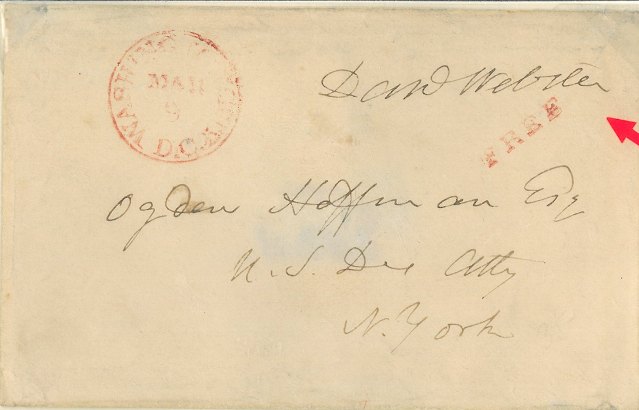
Here is a free frank item sent 1843 and signed by Secretary of State Daniel Webster. This is valid in the exhibiting world because his signature and position had a direct influence on the postal rate, meaning free. Free franking privileges were granted to Secretaries of State from 1792.


Print Friendly and PDF

Ships stranded in the Suez Canal

Now let's dive into today's story. We all remember that there was a another war of survival in our area in 1967 and if you didn’t know, well now you do. The biggest losers were the Egyptians who once again lost control of the entire Sinai Peninsula but it doesn’t really matter as they got everything back again, but that's not the point.

On May 22nd, 1967, Egypt closed the Straits of Tiran and once again blocked the entry of ships on their way to Israel. Déjà vu? After all, in 1956 they did the same thing and the Sinai War broke out. But in June 1967, 14 innocent cargo ships from 8 different countries, entered the Suez Canal on their way north but no one bothered to pick up the phone and warn them that war was about to break out. Now as you now know a war broke out and the Egyptians lost all of a Sinai and finally decided to close the canal, there was no entry and no exit.

So the ships had to dock at a lake called the Great Bitter Lake. They waited there for the war to end. Well this was a short war but they suddenly realized that Egypt was not reopening the canal. "Let us go home" they cried out, but Nasser, the President of Egypt had other plans, the ships were hostages of 8 countries: England, West Germany, Poland, Sweden, Bulgaria, France, USA and Czechoslovakia and why not try to blackmail some of these countries.

The truth is that I do not know if that happened and maybe just telling stories but the fact is that Nasser did not release the ships and Sadat who replaced Nasser also didn’t release them, so they must have had a reason. In essence Egypt only controlled the western side and Israel occupied the eastern side. In practice it was possible to operate the canal together but this was not realistic as it would also allow ships going to Israel to use the canal and it would add salt to their wounds of their great loss and in addition, heaven forbid that an Arab state would cooperate with Israel?

The trapped ships were quite active during the war, using their boats to help Egyptian soldiers who fled Sinai and the doctor on the Polish ship treated about 400 wounded soldiers, very nice of them. There were also about 200 passengers on the ships and at the end of June they were allowed to return home and in August the crews on all the ships were replaced.

Now we have a problem and anyone who has gone through a real lockdown, like Israel’s first Corona lockdown, knows what it is like to be imprisoned in the same place for a long time. So you have a good book, you’re finished in three days; you'll watch a video on the internet, well no, because in 1967 there was no video or internet.

What do bored, restless adults do? Unite! And so the Great Bitter Lake Association was born. The sailors played a wide variety of different activities together such as: cards, chess, table tennis and more. Remember this is a time before Facebook so they had to actually meet, and unlike today, without masks! Who knows when we will return to that? So what else? They played football and handball on the deck of the English ship "Port Invercargill" and of course they had medical service by the doctor from the Polish ship "Djakarta" which we mentioned earlier. The staffs exchanged groceries as well as prepared food, as I teach my daughter "Sharing is Caring". One Swedish ship, the "M/S Killara" had a pool and the other Swedish ship the "M/S Nippon" had a gym. Of course one of their favorite things was movies, not video, there used to be such a thing. In 1968 they all united for an Olympic game of their own.

But how do you communicate with your family? There were no mobile phones, so you need to send letters! And what will they use for stamps? "Let's make them ourselves!" But hold your horse, wait a moment, not everyone can print stamps and mail them, it is not exactly legitimate. If it was legitimate, I would print my own stamps. So in the beginning, towards the end of 1967, the post offices in Egypt, Cairo and Alexandria were very tolerant of the sailors' distress and allowed the letters to be sent without any real stamps and of course the eight countries to which the ships belonged, accepted the stamps of the GBLA and even encouraged the practise. The post office of the organization was on the German ship "Northwind" and everyone gathered there to send and receive letters and the postman took the mail to Egyptian post offices for delivery. Not every postal clerk received the stamps as there was no official procedure in place and quite a few of the postmen demanded that they use regular Egyptian stamps..

Since there was no official status, the GBLA applied to the International Postal Association UPU for recognition since the letters were sent by sea and as of 1891, there was a law that allows letters to be sent by sea, PAQUEBOT and this also applies to the GBLA. The UPU accepted the claim that Clause 21 was valid for these ships and at the end of 1969 introduced a change to the bylaws to allow these stamps and make the practice official and it was accepted as Clause 23.

Only in 1975 did the Suez Canal reopen and the ships were finally allowed to leave the quarantine. But between 1967 and 1975, there was also 1973 and of course the Egyptians attacked Israel. This time the ships were inactive except for one, the American ship "Africa Glenn" which was abandoned and the Egyptian army used it as an observation and direction. As a result, the IDF sank the ship.

Real letters from the first period, that is, until 1970, sell for hundreds of dollars. Personally if I did not know the story behind the stamps, I would laugh at the stamps and think it is not true. They were simple stamps with bad graphics and looked as if they were cut with scissors, but that's the advantage of knowledge and that's why I pass the knowledge on.


The story is based on the stamp catalog of the Slovakian Peter Valdner, the Great Bitter Lake Association. Contact: valdpete@yahoo.com. Here is the site: https://valdpete.blogspot.com/p/great-bitter-lake-association-catalogue.html
Print Friendly and PDF

Tuesday, January 12, 2021

Kalamata Incident

We all know there was a war for Israel’s basic existence in 1948 and if you didn’t, sorry about that. At that time, there was a worldwide boycott of arms sales to Israel except for one country, Czechoslovakia. Whoever thinks that the Americans stood by us at this time, is wrong, this is a pretty common mistake nowadays that is heard mostly on social media.

Why did countries not want to sell us weapons? Good question, and I don’t have many answers only that Western countries did not want to annoy their Arab customers, after all we are a small country compared to the many large countries surrounding us that also had oil. An old joke says that it is a pity that Moshe, our ancestor from the Bible should have turned left instead of right. If he had turned right we would have the oil and the Arabs oranges, referring to Jaffa oranges. Of course it is an old joke, because Jaffa oranges are not what they once were, if there is such a thing today.


Czechoslovakia was willing, but only with Russia's approval, since in 1948 they were a part of the Russian Alliance. And why were they willing, other than to receive money like Pfizer nowadays? 😊 

Well Jan Masaryk, the then Czech Foreign Minister, was a friend of Israel and allowed the sale of weaponry. For those who don’t know, Kfar Masaryk is named after his father. 

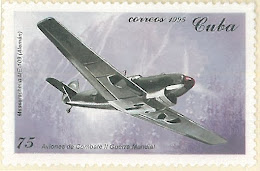
The weaponry we received was the same weapons that they produced for the Nazis. We had soldiers who had previously served in the British Army but who knew how to use German equipment? We also bought planes from them but who knew how to fly a Messerschmitt plane, like the one in the Cuban stamp pictured above? It turns out that no one, and Ezer Weizmann, who was a pilot in the British Air Force during World War Two, knew the British Spitfire plane very well, flew to Czechoslovakia to learn about the Messerschmitt.

Flights from Czechoslovakia to Israel brought small arms and of course mail. There was a war going on, so which flights would bring mail? For some unknown reason they had no emails in 1948, I do not know why. Among the Czech pilots who flew regularly to Israel, was a brave man named Vaclav Fogler.

Fogler wanted to defect to the West and had an exact plan, unlike our government’s, but success depended on him returning to Prague on December 24th (Christmas Eve, when security would be lax) and smuggling his family out. He had to adhere to the strict schedule of leaving Rome on December 21st, flying to Athens, then Lydda (Lod), near Tel Aviv, and back again, a very tight schedule. A round trip in three days, on a Dakota plane? It may sound ridiculous today, because a flight to the Czech Republic is only a few hours, but who wants to go to Prague in the winter?

Nothing happens in a vacuum and in December 1948, something is going on in Greece that could greatly affect Fogler's plan but no one told him about it. Since the liberation of Greece from Nazi occupation, Greek Communist partisans had tried to overthrow the pro-Western government by an open revolt, similar to my previous story, no? England and the United States supported the Greek government and England also served as de facto ruler of Greece during 1948, not exactly an occupation. So on December 21st, 1948, the day Folger left Rome, fierce fighting took place all over Greece, between the government and the rebels. It is important for you to know that the rebels were receiving constant air drops from the Yugoslav Air Force.

British intelligence commanded air traffic control in Greece, including Athens and the airport of Kalamata, a city in southern Greece, and wanted to identify each and every flight before assisting in takeoff and landing, and of course they did not give permits to the Yugoslav Air Force.

When Fogler approached Greece carrying weapons for the IDF, bad weather forced him to deviate from the original flight plan and he radioed this to Athens. There was total darkness and he had no idea where he was and he was unable to identify his whereabouts, He asked for help from the nearest air traffic control to help him identify his whereabouts. He broadcast again and again, and was met with total radio silence. He had no idea that his SOS was actually heard in London, Malta and Tangier he did not know that Greece's air control did not answer intentionally. And why? Because British intelligence believed that the intention of the Czech flight was to drop weapons to the local Communist rebels. Kalamata Airport was less than 60 km away and could easily have handled the Dakota, but the British forced air control not to respond.

The partisans heard the plane in the sky above them and of course assumed that the flight was intended for them. They hurried to turn on lights and other marks on a ridge, suitable for dropping supplies. Poor Fogler thought that the equipment on his plane was not working properly because of the radio silence and was delighted to see the lights. He believed that they were showing a runway that would be suitable for an emergency landing. As he began landing, he suddenly noticed a hill. Unable to climb in time, he collided with the ridge. The Czech airliner crashed near Kalamata, Greece on December 21, 1948.

Of course the partisans pounced on the plane, stole all our weapons and left us with nothing but a few letters that survived the crash. Too bad we did not have insurance. In addition to the pilot, there were other unfortunate passengers on the plane, including fourteen Israelis.

If you had received a letter like the one below, torn, tatty, burned and dirty, wouldn’t you have thrown it in the trash? No? I have not seen many letters that survived this crash and they are of course quite rare but of course they exist. No one knows exactly how many survived. The example below is from my personal collection. The story is based on an article in issue 36 of the journal HLPH.

Print Friendly and PDF

Statcounter