Showing posts with label Crash cover. Show all posts

Tuesday, March 26, 2024

A Double Crash - say no more

In the golden age of aviation, flying was an exhilarating and daring affair, reserved for the privileged few. Taking to the skies was a thrilling experience, and even something as mundane as sending mail by air sparked wonder and amusement among onlookers, like the residents of Tiberius in the 1930s, who marveled at the flying boats landing gracefully on Lake Kineret.

But today, we're not here to talk about the spectacle of early air travel. Instead, we're going to unravel the intriguing tale behind an unassuming cover that most would dismiss as ordinary. Little do they know, this innocuous envelope has a story of daring adventure and calamity that would make even the most seasoned traveler's heart race.

On the 27th of January, 1932, Imperial Airways inaugurated the first regular weekly flight from Cape Town to London, and this cover was a passenger on that maiden voyage. The journey began in Cape Town, with a stopover in Salisbury, Southern Rhodesia. But on the 29th, as the "City of Basra," a mighty Hercules DH.66 flying boat, prepared to take off from Salisbury, disaster struck.

While taxiing on the runway, the aircraft encountered a treacherous patch of soft earth, the remnant of a previously removed anthill. The impact was severe, leaving the majestic flying boat battered and unable to continue its journey. Thus, our unassuming cover earned its first battle scar, a "crash cover" in the parlance of aviation enthusiasts.

Undeterred, the passengers and mail, including our intrepid envelope, were hastily transferred to another flying boat, the "City of Delhi." With hopes high, the flight took off without incident. But the skies had other plans. A violent storm descended upon the aircraft, forcing an emergency landing in a swamp 50 miles from Broken Hill, Northern Rhodesia. Can you believe the misfortune? Two crashes in as many days!

As if the ordeal wasn't harrowing enough, the crew and passengers found themselves marooned in the swamp, their only salvation the prospect of being spotted by another passing flight. Two search planes scoured the area, but the relentless rain hampered their efforts. Finally, the "City of Baghdad" took to the skies, and its crew's sharp eyes located the stranded travelers.

With relief and resilience, the mail, including our indomitable cover, was carried by native bearers to Broken Hill, arriving on the 4th of February. From there, it was loaded onto the "City of Baghdad" for the final leg of its journey to London, bearing the scars of its remarkable odyssey.

So, the next time you come across an ordinary-looking envelope, pause and consider the extraordinary tales it might hide. This cover, which most would dismiss as unremarkable, has a story of daring, calamity, and perseverance that would make even the most seasoned adventurer's heart swell with admiration.

Print Friendly and PDF

Friday, June 4, 2021

A cold war incident

In a previous blog post, we learned that of all the countries in the world, only Czechoslovakia was selling arms to Israel and only because mother Russia, or Big Daddy, allowed them to.

Now Mommy Russia was not doing it out of the goodness of her heart, oh no, who would do that? Russia was one of the countries that immediately recognized the new state of Israel, albeit three days later. Maybe it took the email three days to arrive.

So why? Well the Cold War between the west and the east had begun in 1947 and tensions were high. The cold war actually started in 1947 with what was called the Truman Doctrine. The Americans did not want Russia to spread communism around the globe, they wanted to spread democracy instead. Good luck with democracy in Islamic countries, but that is another issue.

Many of the big boys in the Jewish State had origins in the eastern bloc. Many even spoke Russian. OK they also spoke English, German, Yiddish, French and nonsense, but since when is that relevant. So the Russians naturally thought that Israel would become a Russian satellite. Who knows they may even become a communist country.

America, on the other hand, did not trust the Jewish State for the same reason and placed an arms embargo. Actually POTUS called David Ben Gurion just before the declaration and begged him not to declare independence. The American Secretary of State George Marshall did not believe that the Jewish State would survive the war and did not want to support it. WW2 had just ended. He also did not want to loose the Arab countries. Logical after all, they had more money and were huge.

England did not want Israel not as a Jewish State and not as anything and some of their Spitfire jets attacked Israel. Some of their soldiers were actually caught as prisoners of war. Their ships still patrolled the port of Haifa after the Mandate ended and one of their generals, Glubb Pasha, was in charge of the Jordanian Legion.

But after the war, Israel did not become a satellite of Russia, nor did it buy arms from them. They bought from France. However Israel was not really on either side, the new kid just wanted to survive. Can't really blame her, right? She was faced with belligerency on all sides and constantly attacked and the world did nothing. Wait are we talking about 2021 or 1950?

Now tensions between East and West are high and the west had created the NATO defense pact. In May 1955, the Soviet Union and her satellites created their own defense pact, the Warsaw Pact. Bulgaria was one of the countries which was a part of that pact and there begins our story of the day.

EL AL, Israel's state airline, which was once jokingly referred to as Every Landing Always Late, was on a routine flight from London to Tel Aviv on the evening of Tuesday, July 26, 1955. It departed Heathrow Airport en route to Lod (today Ben-Gurion International Airport), via Vienna and and then Istanbul. After a brief layover at the Austrian capital, the Lockheed Constellation – a four-engine propeller plane – took off for Istanbul shortly before 3 A.M. on July 27.

Soon after takeoff, the flight encountered a thunderstorm, something that was known to cause distortions in the old-fashioned NDR navigation system in use in those days. In the case of LY-402, which was flying along the “Amber 10” air lane, it appears that the pilot changed course after concluding incorrectly that he had passed over the Skopje (Macedonia) navigation beacon. This change of direction caused the aircraft to cross from Yugoslavia into Bulgaria, near the border village of Tran.

Detecting the violation of its airspace, the Bulgarian air force scrambled two MiG-15 “Fagot” jet fighters from the Dobroslavtsi airfield to intercept the intruder. The plane flew over Bulgaria for 200km with the two Bulgarian jets trailing it for most of that distance, and at the time the pilots claimed to have issued several warning shots, but this claim was soon retracted. According to a history of Bulgarian aviation, the deputy commander of Bulgarian air defense, Gen. Velitchko Georgiev, told the two pilots, “If the plane is leaving our territory, disobeying orders, and there is no time left for more warnings, then shoot it down.”

What’s clear is that, as the civilian plane neared the country’s southern border and was about to cross into Greek airspace, the MiGs fired at it. The Constellation exploded at an altitude of 2,000 feet, with its pieces falling to earth near Petrich, Bulgaria. 51 passengers and seven crew members were killed.


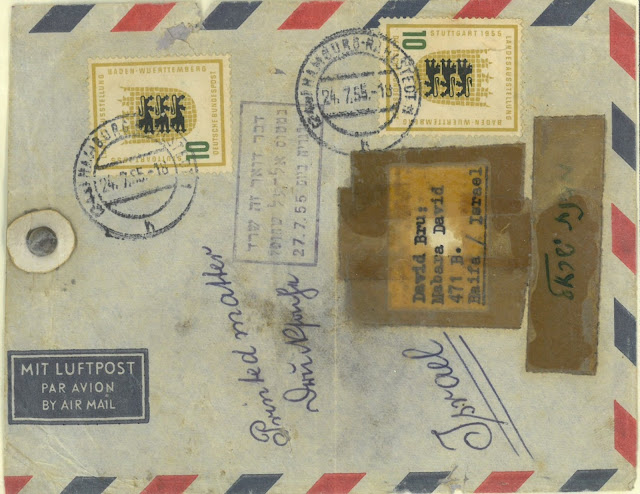
The cover depicted above survived the crash. There is a Hebrew violet cancel: "This letter survived the EL AL flight that was brought down in Bulgaria, 27/7/55"

What happened and why? There was speculation that the Constellation plane was being used by the American Air Force for intelligence activities and was involved in espionage on Bulgaria and they didn't want the plane to leave Bulgarian air space. In fact, the plane that was used by EL AL was the same type as the American intelligence gathering plane.

One researcher concluded that “The Bulgarians wanted to demonstrate to the Soviets their power and their ability to control their airspace, to prove their loyalty and that they were worthy of the mission and purpose that had been delegated to them”.

Although the Bulgarian government at first refused to accept responsibility, blaming the Israeli airliner for penetrating its airspace without authorization, it eventually issued a formal apology, stating that the fighter pilots had been “too hasty” in shooting down the airliner, and agreed to pay compensation to the victims’ families. The compensation amount was a joke, each of the families of the victims received $8,236 which corresponded to the maximum compensation payment fixed by the Warsaw Convention for damage claims of individuals against foreign governments. 

Print Friendly and PDF

Tuesday, January 12, 2021

Kalamata Incident

We all know there was a war for Israel’s basic existence in 1948 and if you didn’t, sorry about that. At that time, there was a worldwide boycott of arms sales to Israel except for one country, Czechoslovakia. Whoever thinks that the Americans stood by us at this time, is wrong, this is a pretty common mistake nowadays that is heard mostly on social media.

Why did countries not want to sell us weapons? Good question, and I don’t have many answers only that Western countries did not want to annoy their Arab customers, after all we are a small country compared to the many large countries surrounding us that also had oil. An old joke says that it is a pity that Moshe, our ancestor from the Bible should have turned left instead of right. If he had turned right we would have the oil and the Arabs oranges, referring to Jaffa oranges. Of course it is an old joke, because Jaffa oranges are not what they once were, if there is such a thing today.


Czechoslovakia was willing, but only with Russia's approval, since in 1948 they were a part of the Russian Alliance. And why were they willing, other than to receive money like Pfizer nowadays? 😊 

Well Jan Masaryk, the then Czech Foreign Minister, was a friend of Israel and allowed the sale of weaponry. For those who don’t know, Kfar Masaryk is named after his father. 

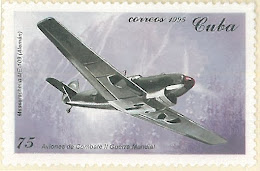
The weaponry we received was the same weapons that they produced for the Nazis. We had soldiers who had previously served in the British Army but who knew how to use German equipment? We also bought planes from them but who knew how to fly a Messerschmitt plane, like the one in the Cuban stamp pictured above? It turns out that no one, and Ezer Weizmann, who was a pilot in the British Air Force during World War Two, knew the British Spitfire plane very well, flew to Czechoslovakia to learn about the Messerschmitt.

Flights from Czechoslovakia to Israel brought small arms and of course mail. There was a war going on, so which flights would bring mail? For some unknown reason they had no emails in 1948, I do not know why. Among the Czech pilots who flew regularly to Israel, was a brave man named Vaclav Fogler.

Fogler wanted to defect to the West and had an exact plan, unlike our government’s, but success depended on him returning to Prague on December 24th (Christmas Eve, when security would be lax) and smuggling his family out. He had to adhere to the strict schedule of leaving Rome on December 21st, flying to Athens, then Lydda (Lod), near Tel Aviv, and back again, a very tight schedule. A round trip in three days, on a Dakota plane? It may sound ridiculous today, because a flight to the Czech Republic is only a few hours, but who wants to go to Prague in the winter?

Nothing happens in a vacuum and in December 1948, something is going on in Greece that could greatly affect Fogler's plan but no one told him about it. Since the liberation of Greece from Nazi occupation, Greek Communist partisans had tried to overthrow the pro-Western government by an open revolt, similar to my previous story, no? England and the United States supported the Greek government and England also served as de facto ruler of Greece during 1948, not exactly an occupation. So on December 21st, 1948, the day Folger left Rome, fierce fighting took place all over Greece, between the government and the rebels. It is important for you to know that the rebels were receiving constant air drops from the Yugoslav Air Force.

British intelligence commanded air traffic control in Greece, including Athens and the airport of Kalamata, a city in southern Greece, and wanted to identify each and every flight before assisting in takeoff and landing, and of course they did not give permits to the Yugoslav Air Force.

When Fogler approached Greece carrying weapons for the IDF, bad weather forced him to deviate from the original flight plan and he radioed this to Athens. There was total darkness and he had no idea where he was and he was unable to identify his whereabouts, He asked for help from the nearest air traffic control to help him identify his whereabouts. He broadcast again and again, and was met with total radio silence. He had no idea that his SOS was actually heard in London, Malta and Tangier he did not know that Greece's air control did not answer intentionally. And why? Because British intelligence believed that the intention of the Czech flight was to drop weapons to the local Communist rebels. Kalamata Airport was less than 60 km away and could easily have handled the Dakota, but the British forced air control not to respond.

The partisans heard the plane in the sky above them and of course assumed that the flight was intended for them. They hurried to turn on lights and other marks on a ridge, suitable for dropping supplies. Poor Fogler thought that the equipment on his plane was not working properly because of the radio silence and was delighted to see the lights. He believed that they were showing a runway that would be suitable for an emergency landing. As he began landing, he suddenly noticed a hill. Unable to climb in time, he collided with the ridge. The Czech airliner crashed near Kalamata, Greece on December 21, 1948.

Of course the partisans pounced on the plane, stole all our weapons and left us with nothing but a few letters that survived the crash. Too bad we did not have insurance. In addition to the pilot, there were other unfortunate passengers on the plane, including fourteen Israelis.

If you had received a letter like the one below, torn, tatty, burned and dirty, wouldn’t you have thrown it in the trash? No? I have not seen many letters that survived this crash and they are of course quite rare but of course they exist. No one knows exactly how many survived. The example below is from my personal collection. The story is based on an article in issue 36 of the journal HLPH.

Print Friendly and PDF

Statcounter