Showing posts with label War of Independence. Show all posts

Saturday, September 18, 2021

Jerusalem is under siege

Today I have a surprise for you. A very good friend has volunteered to write something for us. So thank you Yoram Lubianiker for joining us.

On November 29th 1947, the General Assembly of the United Nations adopted a resolution (#181) for the termination of the British mandate. Palestine was to be divided into a Jewish state and an Arab state, with Jerusalem as a Special International Regime. The resolution was accepted by the Jewish side with great enthusiasm.

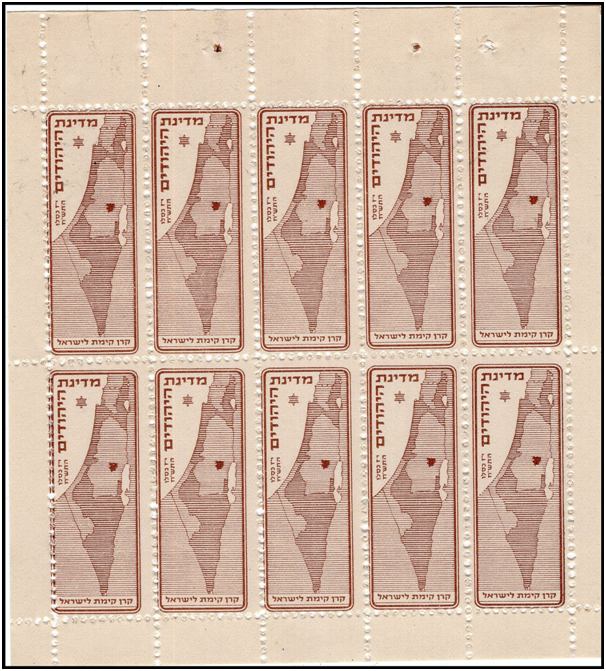
One of the manifestations of this reaction was a label issued by the Jewish National Fund (JNF), entitled “The Jewish State” which shows the map of the partition plan. The Jerusalem area is marked in red, and is completely surrounded by Arab territory. 

A full sheet of the JNF label

While the Jewish side rejoiced the upcoming Jewish state, the Arabs completely rejected the partition plan, both before and after the UN resolution. In fact, Arab riots began on November 30th, the day after the UN resolution was reached, and those riots gradually escalated into war.

Alexander Lustig
A prominent feature of the Arab war plan was to target Jewish settlements whose supply lines were under Arab control. One example was Gush Etzion – a group of four Jewish settlements which were located a few kilometers south of Jerusalem. On January 16th a platoon of 35 Jewish soldiers who were sent by foot to reinforce Gush Etzion was attacked by superior Arab forces. All the members of the platoon were killed and their bodies were viciously mutilated. Among them was 24 years old Alexander Lustig, a holocaust survivor who worked as a graphic designer for the JNF. As a JNF employee, Lustig was exempt from military service, but he felt the need to take part in the battle for an independent Jewish state and volunteered to serve. Just before he was drafted Lustig completed the design of the JNF label shown above.

Jerusalem was a city with a large Jewish population, located in an Arab dominated vicinity, as the map above shows. From December 1947, Jewish Jerusalem was under a de-facto siege. Transportation to the city from the west (i.e., from the Jewish area) was limited to the only road in existence, and that road was under constant attack. Therefore supplies were brought in by convoys, many of which were unable to break through. Things went from bad to worse as the British mandate came to an end.

On May 2nd, 1948 the Mandate postal services were terminated. Throughout the country, the Jewish population started operating its own mail service, using JNF labels that were converted into postage stamps using the overprint “דאר” (Doar = post), see the post When is a label not a label. These overprints were produced in Tel Aviv and in Haifa, and exist on numerous different JNF labels. Since Jerusalem was under siege, the overprinted stamps could be delivered to Jerusalem. Instead, “The Jewish State” labels were overprinted locally in Jerusalem for intracity postal usage, as well as for a handful of letters that were flown from the city to Tel Aviv.

On May 16th, after the State of Israel was founded, the Israeli post issued its first stamps, a set of stamps  known as “Doar Ivri”. Of course they could not be delivered to Jerusalem due to the siege, so the usage of the overprinted JNF labels of “The Jewish State” continued there for a while.

The letter seen below was sent from besieged Jerusalem to Ra’anana via Tel Aviv. It is franked with JNF “The Jewish State” labels overprinted with the word “דאר” and a face value of 10 mils – the postal rate for letters within the country at the time. There were 3 different overprints, and the one shown here belongs to the second issue.


 At that point in time, there were no regular postal connections between Jerusalem and the rest of the country, and letters submitted to the post offices in Jerusalem were held in the post office until the siege was partially lifted (the so-called first and second convoys of the ceasefire). The sender of this letter either had some postage privileges due to his position or (which is more likely) knew someone who was in a position to help. Therefore, this letter was one of the very few that were taken by the very few airplanes that flew between Jerusalem and Tel Aviv. The letter thus arrived at Army Post Office “Base A” in Tel Aviv, where it was cancelled on June 9th. It was subsequently forwarded to its destination in Ra’anana, either by courier or by the Israeli post.

Despite toning that developed over the years in different places this is a very rare cover, that commemorates the siege imposed by the Arabs on Jerusalem.

Print Friendly and PDF

Tuesday, March 9, 2021

Whiskey Mail

Our story, this time, is particularly interesting, as are all of them in my own humble opinion, and I am telling it because of a previous story and you will soon understand why. Remember there was a war of survival in Israel in 1948? So the city of Safed, which is located somewhere in the north of the country, is not exactly a new city and the fortress in the city was actually built by the Crusaders. For religious Jews, it is one of the four most important cities in the Holy Land and people who study Kabbalah, the Jewish mysticism, like the singer Madonna or Esther for you, tend to visit it, both publicly and secretly, well it is hard to do anything secretly in the modern world i.e. Facebook.

When the UN announced their Partition Plan in 1947, everyone knew there would be a war for our survival in the country and we knew it because the Arab countries said so, several times. Too bad we did not know about Daniel Webster then. Actually the war or at least the skirmishes, started in early 1948 and there were many. It was the war of the roads.

And this brings us back to the events of Safed. In 1929, in one of the riots of Arab residents, about 20 Jewish residents were murdered and since in 1948, there were 6 times more Arabs than Jews in the city, and quite a few of the Jews were old men, the Jewish residents knew they were in trouble. So what could they do? Pack up and leave? No! Stay and everything will be fine, or not. Most of them stayed and it began, and hard. Already in early January, Arabs attacked the Jewish Quarter, and in February, they attacked a Jewish bus on its way to Safed and many other incidents.

In early February, Arab forces killed a Jew at the entrance to the post office in Safed, and the British immediately closed the post office on the grounds that it was too dangerous for them and everyone else. The British army controlled Safed but did not raise a hand to stop the attacks on Jews. This meant that there were no postal services for the residents, at least not for the Jewish residents. There was some contact with the neighboring city of Rosh Pina, that Palmach soldiers came by foot through Mount Canaan to fetch mail, after all there was no WhatsApp at the time and they still had to get messages. Of course the amount of mail was limited.

In March, Jewish traffic on the Rosh Pina road - Safed Road, was attacked and as a result the road to the east was closed. From the west the road passed through two hostile Arab villages and Jews could not travel on it. So the Jewish community was under siege, difficult to enter and difficult to leave. They were dependent on the good will of the British soldiers and anyone who knows history, then and today, knows that they were never very fond of us.

Suddenly on April 15 The British announce that they were leaving. They offered to evacuate Jewish elders and women and children with them, but no one wanted to, after this was their home for centuries. "We are staying put!" The British thought the Jews would last maybe two hours after they left.

Is this the end? of course not. Palmach forces arrived to replace the British but the amount of Jewish soldiers was far less than the Arab forces and of course they had much less weapons. The Arab forces approached the Jewish Quarter and the residents felt they were in trouble. The Jewish Quarter being under siege, lacked basic products such as flour and water and more. What do we do?

As we mentioned in one of the previous newsletters, no one wanted to sell us weapons, so either we bought, steal or make our own. One of our inventions was a mortar called the "Davidka" or "Little David", so named after its inventor, David Leibowitz. Her missiles were noisy, very noisy, and very inaccurate and therefore of little value. But what to do, there are no other weapons so started using Davidka and bombing the Arab quarter in the city. The terrible noise so frightened the Arabs that they just ran away. They abandoned the city, and Safed fell to us.

Mahmoud Abbas, who was born in Safed in 1935, says that they fled in 1948 because they thought the Jews would slaughter them. Probably ran away because of the Davidka.

Well I told you a bit of the history and you may be asking yourself or not, what has this going to do with philately apart from the Davidka stamp? So, I told you that from February there was been no post office in Safed, after the British closed it, and I told you that Palmach soldiers managed to deliver some letters. But in Safed there were merchants and banks, and there was one bank, Klinger Bank, which had a local branch. That branch was attacked in the Arab riots of 1929 and twenty years later chaos returned!

The postal service was important to conserving the day to day business of the bank. How can they continue to function and communicate with the outside world, even with Rosh Pina, without orderly postal services? But what could they do, there was none, the British stopped it lock, stock and barrel.

Mr. Klinger took advantage of his good relationship with some of the higher ranks of the British military who controlled Safed and got their permission for British soldiers, who travelled freely on the road between Rosh Pina and Safed, would bring mail bags in their trucks. Knowing that they were returning home in a few months, an order from above did not mean that they would carry it out. Why take unnecessary risks? Mr. Klinger found a nice way to motivate the soldiers. I hope my managers are reading the blog right now, he promised a bottle of whiskey to every soldier that completes his task, meaning delivers the mail bag. A bottle of whiskey per bag mail that they delivered and this time the purpose of the whiskey was for drinking and not for washing hands or disinfection. Message to my boss, Blue Label is appeals to me, hint, hint...

All letters that arrived in Safed during the British Mandate between March 1 and 16 April, are known as "Whiskey Covers".

The story is taken from the book of Postal History of the Transition Period of Israel, 1948 Part I.


I don't have one in my collection. The item depicted here was in an auction of Tel Aviv Stamps.


Print Friendly and PDF

Tuesday, January 12, 2021

Kalamata Incident

We all know there was a war for Israel’s basic existence in 1948 and if you didn’t, sorry about that. At that time, there was a worldwide boycott of arms sales to Israel except for one country, Czechoslovakia. Whoever thinks that the Americans stood by us at this time, is wrong, this is a pretty common mistake nowadays that is heard mostly on social media.

Why did countries not want to sell us weapons? Good question, and I don’t have many answers only that Western countries did not want to annoy their Arab customers, after all we are a small country compared to the many large countries surrounding us that also had oil. An old joke says that it is a pity that Moshe, our ancestor from the Bible should have turned left instead of right. If he had turned right we would have the oil and the Arabs oranges, referring to Jaffa oranges. Of course it is an old joke, because Jaffa oranges are not what they once were, if there is such a thing today.


Czechoslovakia was willing, but only with Russia's approval, since in 1948 they were a part of the Russian Alliance. And why were they willing, other than to receive money like Pfizer nowadays? 😊 

Well Jan Masaryk, the then Czech Foreign Minister, was a friend of Israel and allowed the sale of weaponry. For those who don’t know, Kfar Masaryk is named after his father. 

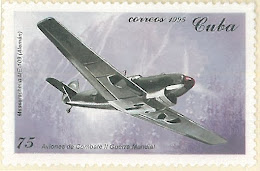
The weaponry we received was the same weapons that they produced for the Nazis. We had soldiers who had previously served in the British Army but who knew how to use German equipment? We also bought planes from them but who knew how to fly a Messerschmitt plane, like the one in the Cuban stamp pictured above? It turns out that no one, and Ezer Weizmann, who was a pilot in the British Air Force during World War Two, knew the British Spitfire plane very well, flew to Czechoslovakia to learn about the Messerschmitt.

Flights from Czechoslovakia to Israel brought small arms and of course mail. There was a war going on, so which flights would bring mail? For some unknown reason they had no emails in 1948, I do not know why. Among the Czech pilots who flew regularly to Israel, was a brave man named Vaclav Fogler.

Fogler wanted to defect to the West and had an exact plan, unlike our government’s, but success depended on him returning to Prague on December 24th (Christmas Eve, when security would be lax) and smuggling his family out. He had to adhere to the strict schedule of leaving Rome on December 21st, flying to Athens, then Lydda (Lod), near Tel Aviv, and back again, a very tight schedule. A round trip in three days, on a Dakota plane? It may sound ridiculous today, because a flight to the Czech Republic is only a few hours, but who wants to go to Prague in the winter?

Nothing happens in a vacuum and in December 1948, something is going on in Greece that could greatly affect Fogler's plan but no one told him about it. Since the liberation of Greece from Nazi occupation, Greek Communist partisans had tried to overthrow the pro-Western government by an open revolt, similar to my previous story, no? England and the United States supported the Greek government and England also served as de facto ruler of Greece during 1948, not exactly an occupation. So on December 21st, 1948, the day Folger left Rome, fierce fighting took place all over Greece, between the government and the rebels. It is important for you to know that the rebels were receiving constant air drops from the Yugoslav Air Force.

British intelligence commanded air traffic control in Greece, including Athens and the airport of Kalamata, a city in southern Greece, and wanted to identify each and every flight before assisting in takeoff and landing, and of course they did not give permits to the Yugoslav Air Force.

When Fogler approached Greece carrying weapons for the IDF, bad weather forced him to deviate from the original flight plan and he radioed this to Athens. There was total darkness and he had no idea where he was and he was unable to identify his whereabouts, He asked for help from the nearest air traffic control to help him identify his whereabouts. He broadcast again and again, and was met with total radio silence. He had no idea that his SOS was actually heard in London, Malta and Tangier he did not know that Greece's air control did not answer intentionally. And why? Because British intelligence believed that the intention of the Czech flight was to drop weapons to the local Communist rebels. Kalamata Airport was less than 60 km away and could easily have handled the Dakota, but the British forced air control not to respond.

The partisans heard the plane in the sky above them and of course assumed that the flight was intended for them. They hurried to turn on lights and other marks on a ridge, suitable for dropping supplies. Poor Fogler thought that the equipment on his plane was not working properly because of the radio silence and was delighted to see the lights. He believed that they were showing a runway that would be suitable for an emergency landing. As he began landing, he suddenly noticed a hill. Unable to climb in time, he collided with the ridge. The Czech airliner crashed near Kalamata, Greece on December 21, 1948.

Of course the partisans pounced on the plane, stole all our weapons and left us with nothing but a few letters that survived the crash. Too bad we did not have insurance. In addition to the pilot, there were other unfortunate passengers on the plane, including fourteen Israelis.

If you had received a letter like the one below, torn, tatty, burned and dirty, wouldn’t you have thrown it in the trash? No? I have not seen many letters that survived this crash and they are of course quite rare but of course they exist. No one knows exactly how many survived. The example below is from my personal collection. The story is based on an article in issue 36 of the journal HLPH.

Print Friendly and PDF

Statcounter