Sunday, January 14, 2024

Using QR Codes in Exhibits and in your own collection

A philatelic exhibition has three main viewers, whose aims are different, but you have to capture the attention of all three. These viewers are: the judges, the public and you.

When it is you, at least in my opinion, there is a lot of satisfaction in working for months, and then seeing your work displayed for all to see.

For the general public, they will pass through an exhibit and if it is an interesting subject for them, they will spend more time on it than on others. If the exhibit was awarded a very good medal, same thing, more time than on others. Many may use it to get ideas from for their own exhibits or collections or sometimes just to write an article about this. Actually some viewers may have more knowledge than you do on the subject and may find mistakes in your knowledge, or know of material that you are unaware of. I found that issue when viewing a particular exhibit at Capex22.

For the judge, poor guy, he has less than half an hour to check out your exhibit and decide what you get. Some judges are very knowledgeable, and have a wide range of knowledge. With the limited time that a judge has, he is not able to read every page and view every item. Of course the bigger the item, the more the eye will be drawn to it. It also matters where the page is on the frame. However if you have an 1870 Queen Victoria ½d Bantam stamp, where the size of the stamp is half the height of a Penny Red and that stamp is in the bottom row, then good luck to you.

So the idea is that you need to make your pages eye-catching and eye-pleasing, you need to make all viewers WANT to look at your pages and you need to direct them to special items. How do you do that? The jury is still out on that.

In my exhibit I have some stamps that I need to write a philatelic explanation of them and the philatelic explanation will be a lot bigger than the stamp itself. Exhibit regulations state that:
The presentation and the accompanying text of the exhibit should be simple, tasteful and well balanced. It should add information to that provided by the material and show the level of understanding of the subject and the personal research of the exhibitor.

Let me give an example of the dilemma. Suppose you want to use the Sachsenhausen Concentration camp parody of the Great Britain 1935 Jubilee issue. In this case, the forgers wrote “This war is a JEWSH WAR”. Here is an example of what I would like to write in the philatelic text:
Heinrich Himmler came up with the idea of counterfeiting British postage stamps in order to convey that the war was a Jewish conspiracy and an attempt by them at world domination. Forgeries of the Silver Jubilee issue of 1935 were prepared at the Sachsenhausen concentration camp. Changes included the insertion of Jewish and communist emblems, placement of Stalin's head, and an inscription "This war is a Jewsh war". The years were altered to 1939-1944
If I used regular A4 paper, it would take up the width of the page. Will this catch the eye of the reader, probably, but who would want to read all that text? In my own opinion it is a presentation problem and then again, partially a development problem because most of the width is taken up. Can the text be more concise, probably a bit? Where is the problem? Not everyone knows the story! Some judges and viewers may not know of this and think that is a nice story. The exhibitor has to get the information across because although this is modern material, it is not readily available, maybe more ready today than in the past, but this falls into the category of philatelic knowledge.

Another example is the set of stamps issued in 1946 by Austria for the "Never Forget" ("Niemals Vergessen") exhibition on the crimes of Nazism. 8 stamps were designed, prepared and printed for the exhibition; however most people don’t know that at the last minute, the Allies placed a veto on two of the stamps, including this stamp on the left, as they were considered to have upsetting or unsettling imagery. Most copies of this stamp were destroyed upon orders of the allies, but of course some had already been sent to dealers etc. The stamp shown here and another was vetoed and were replaced by other stamps and the set was issued. The stamp is not a big stamp, and once again the philatelic text will be long. Again the question is, how do you both tell the audience what they need to know and at the same time, brag, after all this is not common knowledge and nor are the stamps cheap.

The solution is to use a QR Code. Most people already know what a QR Code, we get them on our monthly bills, but for those who don’t a QR code, or quick response code, is a type of barcode that can contain information. It can point to a website, an image, an audio file, send email, be a business card etc. A QR Code can be read by your smartphone camera and immediately direct you to the information. How does that help out? Again I am giving my own solution. I have a blog and a YouTube channel called “Stories Behind the Stamp” and I try to tell the reader or the viewer, the story behind the stamp. This is especially fun when dealing with PostKrieg as many don’t know the stories. So what you can do is to write a blog post and have your QR Code point to that blog post or YouTube video.

Here are two QR codes, the first pointing to my video about the German parody stamp: https://www.youtube.com/watch?v=AicEw-mpeco and the second the blog post about the withdrawn Austrian stamp: https://stampandstories.blogspot.com/2021/08/never-forget.html


I generate my codes from various websites on the web, including https://www.qr-code-generator.com/. Now that we have the codes, what do we do? By the way if you are using white pages, all good, but if your page is a different color, make sure that the image is transparent. Here are the two examples:
There are advantages to this method in that the viewer can take a scan of the QR Code from his phone and then it is saved in his phone’s browser. He can then read in his own free time. In addition the unexpected image next to the item, draws your attention to the item. I have used QR codes whenever the amount of text I want to write starts making the page look full of text, irrespective of the size of the item. The example I have provided are valid for your own collection as well and the use of QR codes in your collection is entirely up to you.

Note: I wrote this article almost two years ago and I was hoping it would be published in TC News but there hasn't been one!

Print Friendly and PDF

Tuesday, September 12, 2023

Going over to the dark side, the Jewish Stereotype

Yes, I went over to the dark side! I became a deltiologist! What a strange word, right? But it is simple, it is a person who collects postcards. Where did they come up with a name like that? Well it turns out that the word originated in 1945 from a collaboration between Professor Rendell Rhoades of Ohio and colleagues at Ohio State University, who am I to disagree.

On the other hand deltiology is the study and collection of postcards. The study is where I come in, because research is what I love. As some of you may know, about a year ago I started investigating the Jewish stereotype on picture postcards and I discovered a new world. My interest was sparked when my best friend asked me to write an article about what does a Jew look like, for a philatelic magazine, and basically there is little!

My research reminded me of times, such as when I was at school and a friend asked my father where he hid his horns, or a time when I went to London and saw a sign, "No Jews or dogs allowed", and this is not so long ago. I decided to research both the postcard and the publisher / artist, wherever possible. This information is very difficult to find and even when you do know the name, little information is available.

New website

I decided to upload all the information I had gathered and I am still gathering, into a new website: https://thejewishstereotypes.blogspot.com in which I try to connect the dots. Please help me out by sharing and commenting on the site itself and if anyone wants to help support me by being me a cup of coffee, then there is a link there.

Thursday, August 3, 2023

YouTube shorts

In case you haven't heard the news, in IBRA in May, I got my very first international Large Gold. This is something I have been working towards for decades, literally, so I am a happy chappy!


As far as my YouTube channel is concerned, I have started doing some shorts which range from less than a minute to two minutes. I am posting some of them here.

Feel free to support me by buying me a cup of coffee. The link is here.


Sunday, June 25, 2023

Throw away or keep?

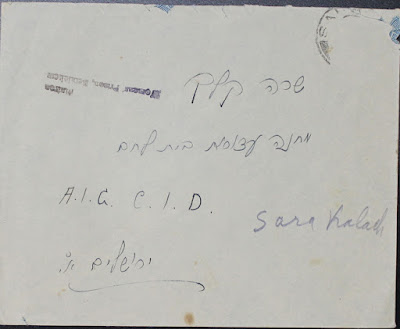
We as stamp collectors deal with stamps, that is why we are known as stamp collectors. As children and many adults, when we get a letter, we tend to remove the stamp from the envelope and put the stamp in our albums and that's it. So what happens when we find a letter like this? As a stamp collector, this letter seemingly has no value. It's missing a stamp. But wait, is it really worthless or should we look into it further?

This letter was written to a woman by the name of Sarah Kalach. Sarah was born in 1928 in Safed and she belonged to a very, very, very old Safed family. They probably got to Safed after the Arab massacre of the Jews of Safed in 1834 which began on June 15th, yes 189 years ago.

As a child, Sarah joined the Etzel movement. Etzel stands for "Irgun Tzvai Leumi" (IZL) which translates to "The National Military Organization in the Land of Israel". As we all know, the British were in control of what was then called the British Mandate for Palestine and the the IZL organization was labeled a terrorist organization by them.
Guerrilla warfare are actions taken against basically military targets, while terrorism is practiced against civilian targets.
That means that Sarah basically belong to a terrorist organization as far as the British were concerned, so her days as a free person were numbered. Sarah was living in Haifa and she got word that the British authorities were looking for her. So she moved to Tel Aviv and after about the year she moved back to Haifa to take care of the branch since many of her colleagues had already been taken prisoner.

In June of 1946 the IZL took part in the King David hotel bombing. The British obviously saw that as a terrorist act, but the IZL group claimed that it was a legitimate target because that was the the British Army Headquarters. Now after this, the British started to crack down big time on the IZL members. As as I said before, Sarah was living in Haifa and somebody spilled the beans and informed the British CID, the Criminal Investigation Department. Heinz Reinhold snitched on her to the CID and he actually told them exactly where to find Sarah.
Sara Kalach, is on the left
On the 29th of October 1946, the British authorities raided the apartment and took her and her brother Shlomo into captivity. Shlomo was actually expelled to Africa, to a detention camp in Kenya. He remained there until after Israeli independence had been declared.

Sarah was sent to the Woman's Detention Camp in Bethlehem and this letter was sent while she was imprisoned there. She was released in March of 1948, along with other woman prisoners, not long before the British left Palestine. Don't worry about her. She got married in 1952 and now has children and grandchildren.

Back to the letter. It was written to Sarah in 1947 when she was in the detention camp, and it was written to her, by her father, Yakov, or they also called him Yankele. The British CID removed the stamp. Why? Because they suspected that messages were written on the back of the stamp. This practice had been in use by the British themselves during the Second World War, So they were aware of the system and they were making sure that messages sent to Sarah didn't bypass the censor of the censor.

And that's the story. Take a simple letter, which you know nothing about, that most people would throw away. I would have, if I didn't know history. This is a lovely case of social postal history.


Print Friendly and PDF

Monday, October 24, 2022

Undercover mail from Iran

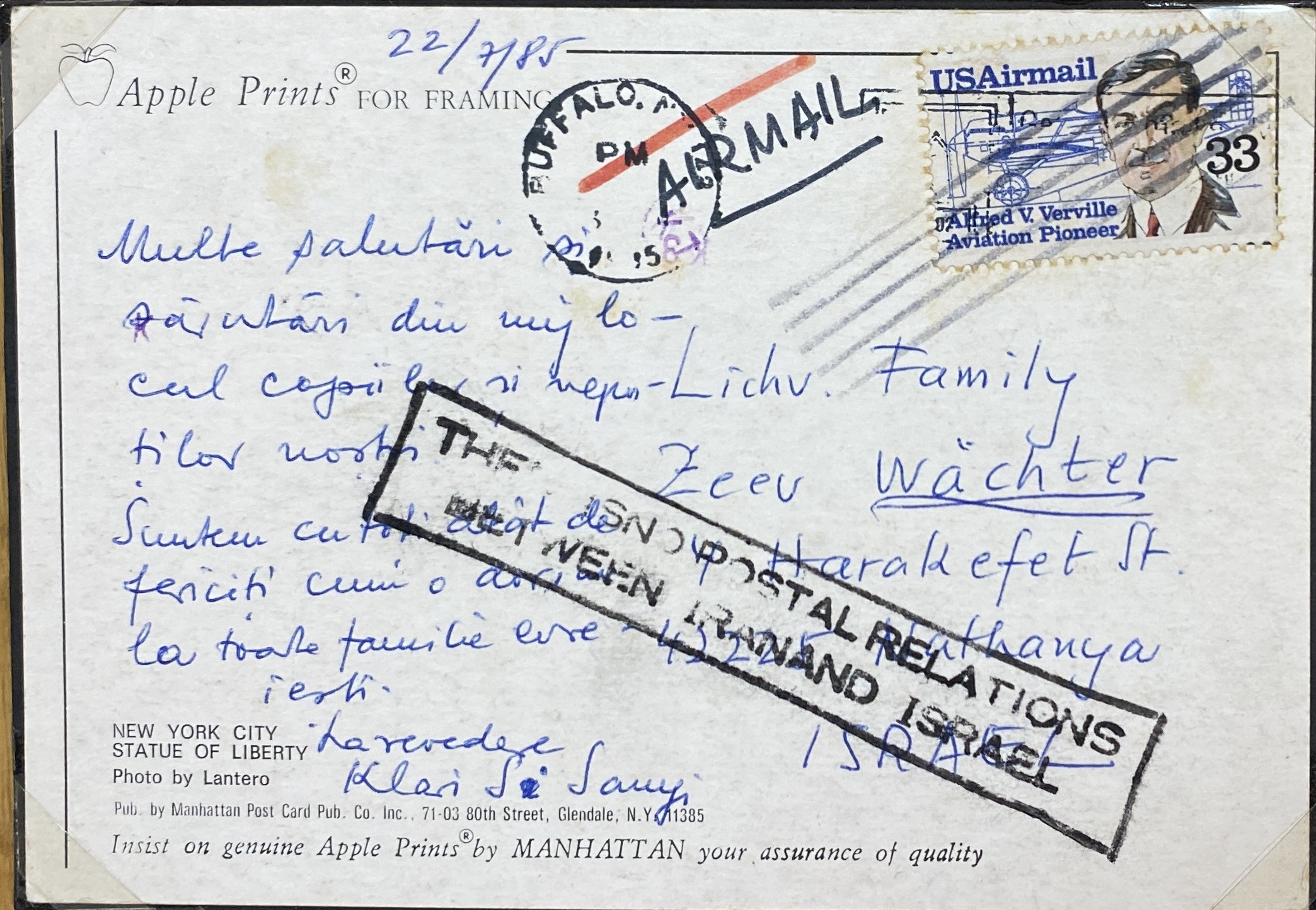
Israel always had good relations with Iran during the regime of the Shah. Iran was one of the few Middle Eastern countries that had any relations with Israel. Mail passed freely between the two countries. When the Ayatollah Khomeini took power in 1979, mail from and to Israel was no longer handled. Mail to Iran was stopped in 1983. Mail from Iran addressed to Israel was returned to sender and received an instructional marking of "There is no postal relations between Iran and Israel". Israel was suddenly cut off from Iran. Note: The actual message was: "Thereis no postal relations between Iranand Israel".

Postcard sent from USA to Israel that was routed in error to Iran. 


In the 1980s, I had a huge interest in mail from Arab countries with no relations with Israel. Items such as the one above were the most difficult to find seeing as how these were pre-Internet days. However I saw an auction lot showing letters from Iran, addressed to Geneva, and it had Hebrew writing on it. This really piqued my interest and I purchased the lot. In those days I worked in a company where there was an Iranian ex-pat and I showed her the lot. She looked at it and said the postbox number looked familiar, so I decided to do some digging.

As I said, there were no postal relations between Iran and Israel, meaning that Jews in Iran couldn't send letters to relatives in Israel. The Israel Broadcasting Authority attempted to fill this void. The I.B.A. set up a post office box in Switzerland (P.O. Box 152, Geneva) which was meant to receive mail sent from Iran. Every day, the I.B.A. broadcast the news in Farsi to listeners in Israel and out of Israel. This transmission was broadcast as far away as Iran. The gist of the broadcast was that listeners could write to "Radio Israel in Farsi" at the given address.

Mail leaving Iran, generally to non-Moslem countries, was often censored by the Iranian authorities and as a result people sending to this drop box did not put a return address on the envelope. Very often people did not even put stamps on the envelope so that they would risk entering a post office. This mail was then taxed by the Swiss Postal Authorities.

Since this service was quite open, there was always the possibility of terrorists using it to send letter bombs. As a result, when suspect mail arrived in Israel's hands, it was screened for letter bombs and "Checked" hand stamps were applied. The security officer who checked the mail signed the hand stamp as proof of its authenticity.


In theory, this could be used by Jews in all countries having no postal relations with Israel, although there were very few as many had been expelled from their host countries.

It is impossible to know how many letters were sent via this method as the Jewish community in Iran is not large and no records are available but it helped Jews in Iran who had no other way of getting word to Israel.


  • "Undercover mail with Iran" ~ Lawrence Fisher, HLPH 57 -58


Print Friendly and PDF

Thursday, September 29, 2022

My problem with eBay

I am a stamp and postal history collector and over the years I have bought items that I would now like to sell duplicates so that I can buy other items I want. As I have been a member of eBay since last century, somewhere in the 1990s, I also sell there, but a year ago, things took a turn for the worse.

Up until then, I was selling on eBay and getting paid in PayPal, in dollars, and that money was used to buy other stamps or to pay for exhibition fees. Now listen to my anti-eBay diatribe:

I charge $4 for postage anywhere with postal relations with Israel. The letter is sent registered mail. Why registered? Because if you do not and the other side complains that it hasn't arrived, eBay immediately refunds the buyer. Fair practice, right! If it is registered, then it has been signed for. If it is lost, you can ask the post office to reimburse, but that has limits as well. They refund up to $50.

So I put an item on eBay for $5, knowing that it is worth $20 (I paid much more) and it gets sold for $5 (that is the name of the game) and then I add the $4 and the buyer pays $9. NOT TO ME, but to eBay. I now have to send this within 4 working days or eBay starts sending me mails and notices whatever.

I then go to the post office to send the item registered, the actual cost is $4.70 but no worries. I pay for this out of my own pocket because eBay has not transferred the money to me. However am I getting the $9, nope, look at this image:


As you can see eBay takes a fee on the entire amount, not just the amount the lot was sold for. Over and above that, they take a fee for sending it international, so the postage is taxed twice.


So eBay will only pay me $7.42 of which $4.70 I had already paid to the post office, so for the item I sold, I am only getting $3 for! Is that fair practice? Of course not, but that is eBay.

Does eBay pay me immediately? Oh no. About a year ago they signed a monopoly deal with a company called Payoneer and you can no longer be paid in PayPal. You have to setup and account in Payoneer and eBay will transfer the money there. When do they transfer? They have two days in a month when they transfer, 1st or the 15th. Sold an item on the 1st, next payout day is 15th, so you have to wait.

End of story, no. eBay wants to make sure that the recipient receives the item. They will not release funds until the recipient has the money. I already paid $4.70 out of my own pocket and I don't have the item or the funds. How does eBay know when the recipient has received it? Either by feedback, or if you show them a mail that he says he received it or the registration number has shown to be delivered. Many countries do not share this information, England, Germany and America are some of those.

If 6 weeks has passed, they transfer the $7.42 to Payoneer, on the payout day.

Yippee, now I can use the money to buy items. Oh no! Payoneer doesn't allow that. I can only withdraw the money to my bank account and they charge $10 for that and only if you have at least $50 in the account and only to that limit. But, if you withdraw then the bank charges you a conversion rate, so more loss. Edited: So I decided that I needed $100 and decided to withdraw it to my bank account. So to get $100, I have to have $110 as that is the Payoneer charge. They used IBAN to transfer to my account and they made me pay the charges of $3. So that is $13 taken off in commission.

What about if you want to buy something on eBay? PayPal or your own credit card! Another foreign currency conversion.

Basically what both of these companies are doing is to make a profit on the money that they are holding, which is rightfully yours.

Edited: Now eBay is taking seller fees, for items that I received cash from, from my credit card and not from Payoneer. I can't even pay for items using Payoneer.

Saturday, September 17, 2022

Don't always believe the auctioneers

Lately I've been trying to build a display page about the national awakening in Europe in the 19th century because this had an impact on the fathers of Zionism. One example of the events taking place in Europe was the unification of Italy and the delayed addition of the Kingdom of Lombardy-Venice.

In 1815, the Congress of Vienna convened, which was intended to shape the map of Europe after the upheavals caused since the French Revolution and during the Napoleonic era. Strangley the Congress determined that the kingdom would be included in the territory of the Austrian Empire. The Kingdom of Lombardy-Venice was Italian speaking and Austria was German speaking, very different cultures, history and languages.

In 1859, Austria was defeated by the Kingdom of Sardinia and France in the Second Italian War of Independence, and was forced to surrender Lombardy to the French Emperor Napoleon III. France, for its part, transferred the territory it had just won to the Kingdom of Sardinia, and thus the end of the unification of Italy was in sight. For the sake of completeness of the historical picture, I will mention that the area of Venice was handed over to Italy only a few years later, in exchange for its participation on the side of Prussia in its war with Austria.

The thematic point that interests me is the handover of Lombardy to Italy in 1859. One day an item caught my eye at a well-known European auction. The title in the auction catalog was:

Sardinian War, 1859: Austria against the Kingdom of Italy - loss of the Kingdom of Lombardy.

Interesting, I said to myself. The Sardinian War is another name for the Second Italian War of Independence, so I should definitely read the auctioneer's description of the item:

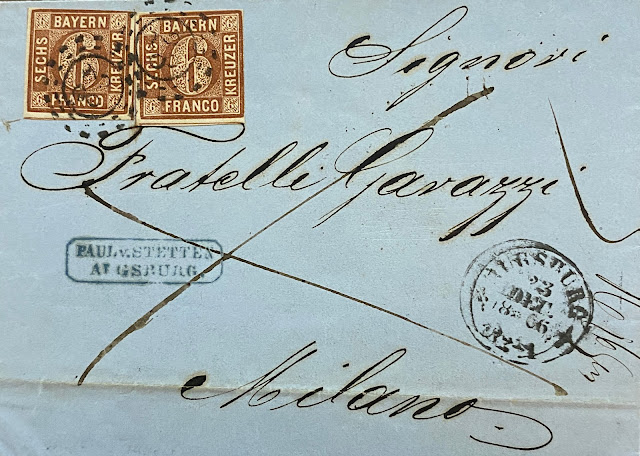
23.12.1856, Augsburg- Milan, 2 double 6 red-brown Kreuzer, on a letter weighing up to 1 luth. At that time Lombardy was still part of Austria, and the letter was sent within the Austro-German postal union. The letter passed through Switzerland, and the Swiss Post received 3 kreutzers in return. Arrival stamp of Milan from December 27, 1856.

Nice, I thought to myself. Augsburg is a city in Bavaria. A luth is a unit of weight that was used at that time in Austria, and is equal to 17 and a half grams. The fact that Lombardy was still part of Austria is exactly the heart of the matter for me. I paid 130 euros for the item, to which were added 65 euros in additional expenses (commission, handling and shipping fees), as well as 110 NIS that I paid to customs in Israel.

The item arrived and I excitedly opened it and then I sat down to examine it more carefully. I immediately had questions. The Bavarian stamps are indeed from the 1850s, but I found no sign of the letter passing through Switzerland or of a payment to the Swiss post office in return. Then I noticed that the year on the stamp is 1866 and not 1856 as written in the sale catalog! In 1866 Lombardy was already part of Italy, and the letter had nothing to do with the Sardinian War that ended seven years earlier.


Here is a classic case of an incorrect item description in the auction catalog. I contacted the auction company, and to their credit they took responsibility for the error and refunded everything including the 10 euros for shipping the item back to them, but not Israeli taxes. I would say "caveat emptor" but in this case, the online image was not clear to see the '66 part.

Fortunately for me if I had trusted the description in the auction catalog, and a judge had caught me out, I would have been embarrassed and lost points on thematic knowledge. I also would not be able to get my money back from the seller, well depending on how much time passed.

Print Friendly and PDF

Statcounter