Tuesday, May 25, 2021

Oops, Spain made a boo boo

In 2020 America lost it. A rogue cop killed a known criminal with whom he had a history with. The murder of George Floyd, a Black man, by a White police officer sparked riots across the United States and around the world, including in Spain, where activists joined the global movement in seeking to raise awareness about discrimination and racism.

During one of the biggest such rallies in Spain, thousands marched in Madrid in June, making their way to the capital’s Puerta del Sol square, a popular spot for rallies and protests.

In May 2021, Spain’s postal service, Correos, decided to jump on the anti-racism and on the first anniversary of George Floyd’s death, issued a set of four stamps with images of skin-tone stamps, the lightest being the most valuable.
“The darker the stamp, the less value it will have. Therefore, when making a shipment, it will be necessary to use more black stamps than white ones. That way, each letter and each shipment will become a reflection of the inequality created by racism.” Correos said in a news release announcing the launch.

This prompted criticism worldwide as the issue itself was considered racist. People criticized the campaign upon its launch, calling it tone-deaf or "accidentally racist."  "Correos is an anti-racist company," said the Correos spokesman, but the damage was done!

The issue was withdrawn after three days. A new rarity? My only question is why are there not protests worldwide when Jews are killed? How often does it reach the headlines?




Sunday, May 23, 2021

Sending mail to forbidden countries

So I am browsing the net, looking for a certain item and I find it. I go through the purchase process and get to shipping and find, what? That Israel is one of the few countries that they don’t ship to. Why is that? Could it be for ideological reasons or could it be that Israeli post has a bad reputation? Doesn’t make a difference, they don’t ship to Israel, yet it is an item I want, be it a cover or an item of clothing. So?

Well today there are services in place, via a third party. You pay for a service which provides you a post box number in, say America, and have them ship there. That same service then collects your parcel from that postbox and forwards it to you for an exorbitant fee and you are happy.

What has that good to do with philately? Good question, thank you for asking. In 1967 Israel took over control of what is known as the West Bank and Gaza and I am intentionally leaving politics out of it here. However, all of a sudden, we have a few millions new inhabitants who are closed off from their family. They can’t use email as it hasn’t been invented yet and they can’t send letters as no postal relations exist between Israel and many of those countries, many who are still in a state of war with Israel.

So what can they do? The answer my friend is not blowing in the wind, it is in the first paragraph. A third part!

The first obvious system was the Red Cross. With the Red Cross you could send a message to anyone via the Red Cross, however these were brief messages and anyone can read them. If you don’t like what is written there, somehow it will not be delivered.

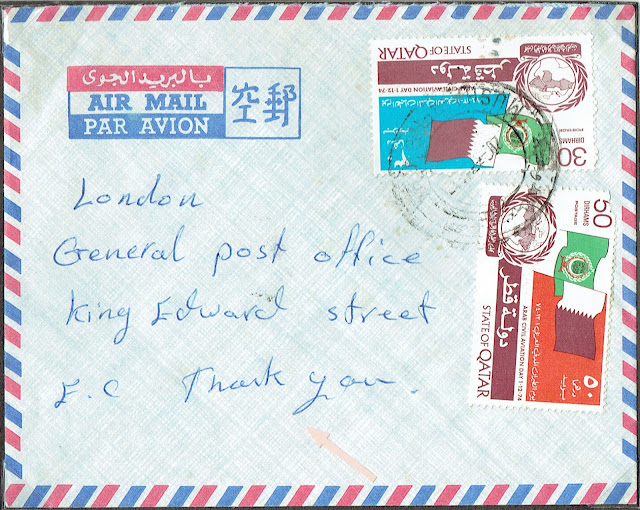
Along comes a bright spark and says, let us send mail via the London Post Master and they did. How did it work? A letter was sent from Israel to the Post Master of King Edwards Street in London. Enclosed in that letter was another letter intended for a third country, say Iraq, and an International Reply Coupon. This coupon was intended for use by the London Post Master to pay for the service. One advantage was that the chances of the mail being read was minimal and you could write whatever you want and how much you want. Actually there was a second address in London and an address in Cyprus.

Ingenious, right? Well it was modelled after the famous World War 2 Thomas Cook service in which someone from Nazi occupied areas could send mail to family or friends living in Great Britain or Palestine, for that matter, to an undercover address of POB 506, Lisbon, Portugal. The Thomas Cook office in Lisbon would then forward the mail to Great Britain or other countries.


From Qatar to London and thanking them for the service

 
In the hopes for peace, Defense Minister Moshe Dayan decided upon an Open Bridges policy, so that people could cross from Jordan to Israel, hopefully for trade or to visit or whatever. Now we have an open bridge and people crossing and what did they do? Well some people took letters for others. They folded them in their pockets and in essence were supposed to go to the Allenby Bridge Post Office, buy stamps and post them, but many didn’t. They were scared of being caught and just shoved the letters in the post box without stamps. Of course the recipient was then forced to pay the postage cost, but also the fine. This method was better than the London idea because it was much quicker.

So we now have a border crossing and people who want to visit, but what is missing? Tourism! After all some of the holiest Christian sites are in what is known as the West Bank. So some tourist companies jumped on the band wagon and purchased Israeli stamps. “If you don’t know anyone crossing the border, send it to us, we will send it”. They obviously charged a nice fee because why do it for nothing. You can see that the fee was paid either by the application of a label or the company’s special cancel.

Label of the Amman Halabi Touring Company. Folded as they probably didn't have stamps yet
  
This practice is sometimes known as undercover mail.

Some of these are in use today. There are people in cities such as Jaffa who buy items locally and send them to countries with no relations or that they don’t want to actively buy from us.

I have outlined some of the methods that our Arab brothers communicate with others, maybe next time I will write about methods that Jews in Arab countries, those that are still left, communicate with Israel.

For more information see "Mail Contacts Between Israel and Arab Countries - a Summary" by Lawrence Fisher, H.L.P.H. Journal VI #109-110, pages 333-353, 2008. 


Print Friendly and PDF

Tuesday, May 11, 2021

Spotlight - My WOW item - an item from the Spanish Inquisition

As exhibitors and collectors we are always after that WOW item, the item that you have been looking for, or the item that you saw and think wow, why didn’t I think of that before. As collectors, it is nice if others look at the item and also say, wow. It is not even a case of money since not every wow item is expensive. For me, I had not really found an item like that in some time.

While in Verona in November 2019, at the ECTP 2019 exhibition, in which I won the Champion of Champion class (hey if I don't blow my own trumpet, who will), I saw an exhibit on Columbus. I discussed with a friend to and we decided to see how the exhibitor approached the issue of Queen Isabella of Spain. I wanted to improve my page about Jews not being wanted.

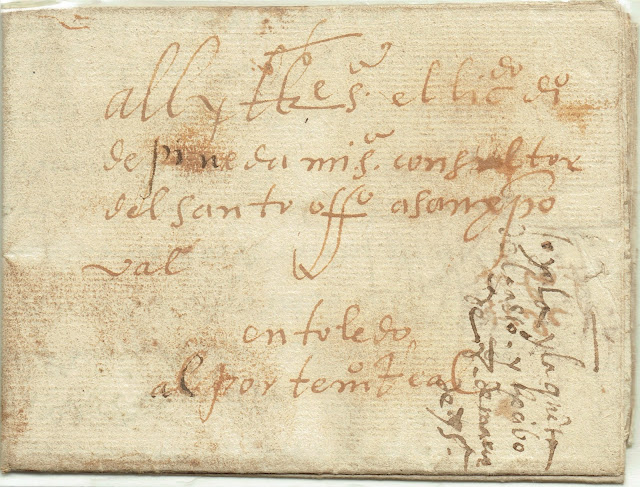
We thought that there may be covers of some kind, sent by Queen Isabella, and then we saw it, the WOW item. It was a cover sent to Friar Diego Pineda of Toledo in 1582. Friar Diego Pineda was an official consultant to the Santo Oficio a San Cristóbal or the Holy Office of the Inquisition. We never even considered this direction.

We will not go into the history of the Inquisition as many of us already know it; the history is not new to us. Just to make it short, the Spanish Inquisition was established in 1478 by Catholic Monarchs Ferdinand II of Aragon and Isabella I of Castile. It was intended to maintain Catholic orthodoxy in their kingdom and to replace the Medieval Inquisition, which was under Papal control.

Basically they said "its our way or the highway" meaning either convert, be killed or leave.

The full name of the Inquisition was Santo Oficio de la Romana y Universal Inquisicion or “Holy Work of the Roman and Universal Inquisition". Santo Oficio means “Holy Job or Work”. Since the name was actually Holy Work of the Roman and Universal Inquisition, it was shortened to el Santo Oficio which was a far more used name for the institution than Inquisition, which was the preferred term of Anglophile countries, most likely because for Protestants, Holy Work sounds too good for the evil abhorrent Catholic tribunal.

The tribunal in Toledo was established in 1485 and the Inquisitor General there presided over the court in the Church of San Cristobal. As yet I have not been able to find information about the consultant just that his full name was Friar Diego Pineda.

The story of the inquisition fits my story perfectly. Now I really needed an item of my own. I approached the exhibitor who put me in touch with a site. I did a search there and found the cover he originally purchased and amazingly found a second item which I immediately purchased.

The cover eventually arrived and it is quite similar. It was also sent from Madrid to Toledo, again to Friar Pineda. Sent 8th March, 1575, and postage paid was ½Real.


Let us get a tad boring for a moment while I explain something. Up until 1580, the mail service within Spain was for the service of kings and nobility. Sending a letter or official documents at this time was very expensive because you had to pay the service of the postman, the benefit of the postmaster, the accommodation and the maintenance of the mail during the route, the food for the horse and others. If the king sent a letter from Madrid to Toledo, the postage rate was 100 Reals. Some private individuals also gave the postman their private correspondence and only paid a token amount of ½ Real, which is what my letter was charged. By doing this, the courier could not ask Friar Diego to pay up.

Now according to exhibiting rules, the name of the recipient does not enable us to use an item, unless the recipient had special postal privileges, in this case the full postage was paid. Does this make it illegitimate? According to the new SREV for thematic, this is considered borderline. It is legitimate because it is the best item to use to display the thematic point, the inquisition.

I now have a WOW item in my exhibit.

Note: This article was previously published in the Israeli Thematic Bulletin and the British THematic bulletin

Print Friendly and PDF

Wednesday, April 28, 2021

Spotlight - Forced to work as a consultant

Hi everyone, welcome back.

I have just sold an interesting cover that I purchased last century for a lot of money and sold it again for a little bit of money. Perhaps I could have sold it for a bit more but I wanted to buy something else and that is the name of the game.

I want to tell you about this item as it is a true piece of history, a piece showing the face of antisemitism, before the Holocaust.

As we all know, the Nazi Party rose to power in 1933 and immediately began issuing many anti Jewish (and others of course) regulations. The underlying idea was to remove non Aryans, mainly Jews, from public life. This became known as the Reich Citizenship Law.

The Fifth Ordinance of the Reich Citizenship Law of 27 September 1938 removed all Jewish lawyers from the bar. They were only allowed to work as consultants to provide legal advice to Jewish clients, Dr Berl Cooper was one such Consultant.

Only 10% of licensed Jewish lawyers were allowed to work as consultants.


Print Friendly and PDF

Tuesday, April 6, 2021

The Swearing Parrot

Now here is a really cool story and thank you to my friend Graham Beck for telling me about this.

At the Canadian Expo in 1967, there was the Guyana Pavilion which they shared with Barbados, probably to save costs. Both countries had recently become independent and this was a huge opportunity to advertise their independence.

They decided to send a number of Macaws, beautiful and colorful parrots that were indigenous to the region and known for their ability to learn and repeat words. One of the parrots was named Millie Amacore and she was going to be the star because, like my daughter, she could speak two languages.

So what happened?

Beautiful Millie apparently arrived at the show several weeks earlier, while construction was still in progress and as parrots do she listened to all the construction workers. Millie picked up the bad language from the construction workers as they were working on the pavilion or maybe they were teaching her?

When the Expo opened in April of 1967, visitors to the Guyana pavilion were greeted with Swearing Millie, in both French and English. So the little bird was expelled, banished, evicted from the world affair. In my opinion she was lucky that didn’t become a tasty dish. Actually I would have thought it was funny but in 1967 I was a young laddie.

But her not being turned into a tasty dish, she was featured on a set of  Christmas stamps from Guyana later that year. As Graham pointed out, Cussing Millie has nothing to do with Christmas, and her sole fame was her astonishing ability to swear in both English and French. But the incident was still fresh in the minds of everyone, so why not promote the young lady? Who knows, it may have brought tourism to the new country.

Note to self, be careful when I swear around my daughter, whether it be English, Hebrew, Spanish, Arabic or whatever. Maybe I should try not to swear until she is 18? Long wait!

Note: I received permission from Graham to do this. You can see the original here
Print Friendly and PDF

Tuesday, March 16, 2021

Operation Cornflakes

Let’s start with today’s story, a story I like to tell many times but I haven’t written about it. I was reminded of this story as a result of the exhibt of a colleague of mine, that of Menachem Lador talking about secret services, another fascinating topic. And here's a link to his display. During a war, there is often an attempt to undermine the morale of the citizens so that they put pressure on their government to end a war. The term is called demoralization. This is usually the case in a war of attrition.

Demoralization is not a new phenomenon and during World War II, both the Allies and the Axis Powers used tactics to try and undermine the morale of citizens. One covert operation created by the Office of Strategic Services (OSS), the American spy agency during World War II that later became the CIA, became known as "Operation Cornflakes." Sounds delicious, doesn't it? A Kellogg's campaign during which you get a knock on the door in the morning and someone hands you a bowl of cornflakes? Well, it's not.

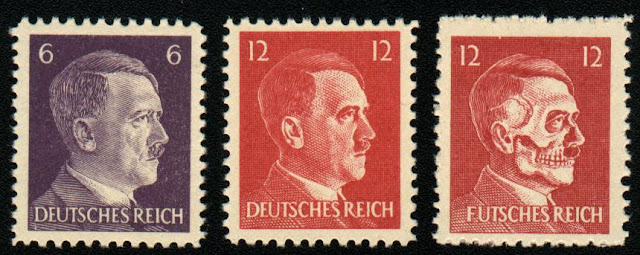
One of the stamps, issued by the Germans was the Hitler head series. So what did the OSS do? They took the stamps (specific values and you will soon understand why) and forged them! Instead of the usual Hitler head, the fakes showed Hitler's head as a skull or "death head." One of the stamps printed the name of the country as "Futsches Reich" which means "ruined empire" instead of "Deutches Reich".

With permission from SGM Herbert A. Friedman

Just as matter of interest, it is documented that Hitler was paid to be able to use his portrait on postage stamps. It was paid for by something called a Cultural Fund. This is also where he was paid the money from hi book, "Mein Kampf"

Our OSS friends led by General "Wild Bill" Donovan, had to learn everything about the German postal service. So what did they do? German Prisoners of War who were former postal workers, were interrogated on every slither of information, from the postage stamps to methods of packing and sealing mailbags. For this work, they received benefits like tastier meals and so on. Anti-Nazi spies and residents, collected samples of cancellers, postage stamps, mailbags and envelopes. They even took German phone books with addresses of the residents. Today with our smartphones, who remembers the piles of phone books next to our telephone that was connected to a wall!

Now they have addresses, fake stamps, mailbags, knowledge of methods, so what's the next step? Writing the letters themselves. The letters were written, full of anti-Nazi propaganda, to as many citizens as possible, using the forged stamp and fake postmark. In each letter they placed the Hitler skull parody stamp. But they then encountered a problem. Without asking anyone, and without informing the OSS, the Germans changed the laws and only allowed mail from legitimate businesses. No problem, the sender's address will carry the addresses of legitimate businesses that they of course took from the phone number. In the interim they duplicated the mail bags and every other detail of the German postal service. What an operation.

The question now is how to insert these letters into the German postal service? After much thought they came to the conclusion that the best way is to bomb mail trains from the air. Once the bombers managed to stop the train, they had to drop the false mailbags into the rubble. Thus, the Germans would find the mailbags and assume that they belonged to the damaged train and transferred them for further treatment and thus reach their destination. This type of propaganda is called black propaganda. Black propaganda is a type of propaganda designed to create the impression that it was created by someone who is supposed to discredit it.

A beautiful story, no? So speaking of letters, why was it called Operation Cornflakes?

In those days, in the United States, cornflakes was a very popular breakfast food and in Germany the mail was delivered at breakfast, so the Allies felt that if German citizens received their demoralization propaganda at breakfast, they would feel that the German Reich was indeed "falling apart." A covert operation named after food!

On February 5, 1945, a German train traveled to the city of Linz. The Mail Car held mail delivered to several towns in northern Austria. Suddenly, Allied planes attacked, dropped bombs, and dropped the mailbags. Eight mailbags hit the ground around the train with a thump. Inside each bag were about 800 propaganda letters, all directed to homes and businesses along the train route and properly addressed. When the train was discovered, German postal workers exchanged bags and forwarded the letters without knowing anything about their contents or origins. The operation had begun.

During the operation, 20 missins of counterfeit mail, with about 320 mailbags and over 96,000 propaganda letters were dropped. Although there was a considerable amount of mail, I have not seen many for sale. A friend sent me a photograph as an example, and it is depicted below.


What is interesting about the story is that the items are relatively difficult to obtain, and therefore there are forgeries on the parody, so you need a certificate to show that it is genuine. Can you imagine a forgery of the forgery? Before you start looking for letters like, remember one thing, the stamps on the letters were not the ones with the skull because people would immediately recognize that it was not real, but most of the time they were inside the letter with the propaganda page. Remember, this is black propaganda!

No one knows how successful the operation was but at least it gave us something to enjoy. The story is based on an article by another colleague of mine. And here's a link.

If you like this post, please leave a comment, even better if you share it.
 
Print Friendly and PDF

Tuesday, March 9, 2021

Whiskey Mail

Our story, this time, is particularly interesting, as are all of them in my own humble opinion, and I am telling it because of a previous story and you will soon understand why. Remember there was a war of survival in Israel in 1948? So the city of Safed, which is located somewhere in the north of the country, is not exactly a new city and the fortress in the city was actually built by the Crusaders. For religious Jews, it is one of the four most important cities in the Holy Land and people who study Kabbalah, the Jewish mysticism, like the singer Madonna or Esther for you, tend to visit it, both publicly and secretly, well it is hard to do anything secretly in the modern world i.e. Facebook.

When the UN announced their Partition Plan in 1947, everyone knew there would be a war for our survival in the country and we knew it because the Arab countries said so, several times. Too bad we did not know about Daniel Webster then. Actually the war or at least the skirmishes, started in early 1948 and there were many. It was the war of the roads.

And this brings us back to the events of Safed. In 1929, in one of the riots of Arab residents, about 20 Jewish residents were murdered and since in 1948, there were 6 times more Arabs than Jews in the city, and quite a few of the Jews were old men, the Jewish residents knew they were in trouble. So what could they do? Pack up and leave? No! Stay and everything will be fine, or not. Most of them stayed and it began, and hard. Already in early January, Arabs attacked the Jewish Quarter, and in February, they attacked a Jewish bus on its way to Safed and many other incidents.

In early February, Arab forces killed a Jew at the entrance to the post office in Safed, and the British immediately closed the post office on the grounds that it was too dangerous for them and everyone else. The British army controlled Safed but did not raise a hand to stop the attacks on Jews. This meant that there were no postal services for the residents, at least not for the Jewish residents. There was some contact with the neighboring city of Rosh Pina, that Palmach soldiers came by foot through Mount Canaan to fetch mail, after all there was no WhatsApp at the time and they still had to get messages. Of course the amount of mail was limited.

In March, Jewish traffic on the Rosh Pina road - Safed Road, was attacked and as a result the road to the east was closed. From the west the road passed through two hostile Arab villages and Jews could not travel on it. So the Jewish community was under siege, difficult to enter and difficult to leave. They were dependent on the good will of the British soldiers and anyone who knows history, then and today, knows that they were never very fond of us.

Suddenly on April 15 The British announce that they were leaving. They offered to evacuate Jewish elders and women and children with them, but no one wanted to, after this was their home for centuries. "We are staying put!" The British thought the Jews would last maybe two hours after they left.

Is this the end? of course not. Palmach forces arrived to replace the British but the amount of Jewish soldiers was far less than the Arab forces and of course they had much less weapons. The Arab forces approached the Jewish Quarter and the residents felt they were in trouble. The Jewish Quarter being under siege, lacked basic products such as flour and water and more. What do we do?

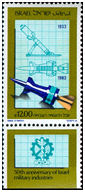
As we mentioned in one of the previous newsletters, no one wanted to sell us weapons, so either we bought, steal or make our own. One of our inventions was a mortar called the "Davidka" or "Little David", so named after its inventor, David Leibowitz. Her missiles were noisy, very noisy, and very inaccurate and therefore of little value. But what to do, there are no other weapons so started using Davidka and bombing the Arab quarter in the city. The terrible noise so frightened the Arabs that they just ran away. They abandoned the city, and Safed fell to us.

Mahmoud Abbas, who was born in Safed in 1935, says that they fled in 1948 because they thought the Jews would slaughter them. Probably ran away because of the Davidka.

Well I told you a bit of the history and you may be asking yourself or not, what has this going to do with philately apart from the Davidka stamp? So, I told you that from February there was been no post office in Safed, after the British closed it, and I told you that Palmach soldiers managed to deliver some letters. But in Safed there were merchants and banks, and there was one bank, Klinger Bank, which had a local branch. That branch was attacked in the Arab riots of 1929 and twenty years later chaos returned!

The postal service was important to conserving the day to day business of the bank. How can they continue to function and communicate with the outside world, even with Rosh Pina, without orderly postal services? But what could they do, there was none, the British stopped it lock, stock and barrel.

Mr. Klinger took advantage of his good relationship with some of the higher ranks of the British military who controlled Safed and got their permission for British soldiers, who travelled freely on the road between Rosh Pina and Safed, would bring mail bags in their trucks. Knowing that they were returning home in a few months, an order from above did not mean that they would carry it out. Why take unnecessary risks? Mr. Klinger found a nice way to motivate the soldiers. I hope my managers are reading the blog right now, he promised a bottle of whiskey to every soldier that completes his task, meaning delivers the mail bag. A bottle of whiskey per bag mail that they delivered and this time the purpose of the whiskey was for drinking and not for washing hands or disinfection. Message to my boss, Blue Label is appeals to me, hint, hint...

All letters that arrived in Safed during the British Mandate between March 1 and 16 April, are known as "Whiskey Covers".

The story is taken from the book of Postal History of the Transition Period of Israel, 1948 Part I.


I don't have one in my collection. The item depicted here was in an auction of Tel Aviv Stamps.


Print Friendly and PDF

Statcounter